
We have all done it. We have all asked a piano student to play “it” one more time. And there’s nothing wrong with this request…
Unless, of course, you have already asked your piano student to play “it” one more time. If this is the case, then it’s very likely you have a frustrated child sitting at your piano bench and it’s time to change your approach.
In today’s post, we want to talk about what teachers can do if their students are getting frustrated with playing a piano piece or practicing a piano skill “one more time”.

Wait… Don’t Abandon Repetition As A Teaching Strategy!
When teachers ask a piano student to play a piece “one more time” they are using repetition as a learning tool. And there is absolutely nothing wrong with repetition as a learning tool. When children repeat a skill or activity over and over and over, they are creating neural connections in their brains that commit that skill to memory. Skill repetition in a piano lesson is, therefore, essential.
Without repetition, piano students will get frustrated with their inability to learn the piano and quit lessons. Ironically, however, too much repetition can also lead to frustrated piano students who quit piano lessons.
The key, therefore, is to use repetition the right way.
Piano Repetition The Right Way
So far, we have told you that repetition is good and repetition is bad. While this seems impossible, it is not.
Repeating the same skill over and over is a wonderful way to learn to play the piano. On the other hand, repeating the same activity that teaches the aforementioned skill over and over can be detrimental to learning. And this is because skills and activities are not the same.
A skill may be the ability to play half notes. An activity may be clapping rhythms with half notes. Another activity may be engaging in a piano game that reinforces aural recognition of half notes. Yet another activity may be playing a “pick-a-path” sight-reading adventure that reinforces half notes. In each case, the same skill (half notes) is being reinforced over and over, but the activity is constantly changing.
And this is the key to using repetition the right way: when teaching kids to play the piano, change the activity, not the skill.
If you have struggling piano students, don’t ask them to play the same line of music again and again and again. Find new and creative ways to help them tackle their troubles that do not involve striking the keys. Get them off the bench or engage their brains in new ways on the bench.
This Seems Like A Lot Of Prep, Help Me!
The problem with using multiple, creative ways to teach the same piano skill is that it requires a ton of prep. It is so much easier to just ask your students to play a measure one more time, or a line one more time, or a piece one more time.
Creative teachers can spend hours every night developing activities, finding manipulatives, searching for motivating repertoire and printing off games. In time, many of these teachers will lose their enthusiasm for piano teaching and burn out.
I have definitely been in this position. There were times in the past when my piano teaching job was a 60 hour work week. I would never wish that on anyone. And it was one of the driving factors that led Trevor and me to develop our WunderKeys Method Books.
We wanted to create an all-in-one resource that would take the pressure out of piano lesson planning so that teachers could focus on what they do best: teach!
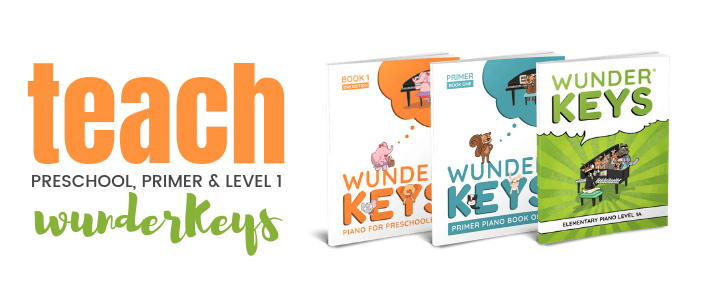
Every single WunderKeys Method Book from preschool to Level 1 is jam-packed with piano activities and repertoire designed to reinforce learning in a multitude of creative ways while letting piano teachers have a life outside of lessons.
As one teacher recently wrote us to say…
“The lessons are so quick and easy to plan and follow. With students happily and consistently progressing with the program exactly as laid out, I almost feel like I’m cheating a little. More of my time outside of lessons is spent with my family instead of on prep work, and I don’t have to wonder how to keep things exciting while still staying focused on goals.”
If you want to spend your after-lesson hours with family and friends rather than frustrating internet searches for piano materials, check out our WunderKeys Method Books and supplementary repertoire on Amazon.
I use the repetition card you made with wunderkeys, when a little help is needed in a piece. My young ones love those, it is visual and they know how many more!
Fabulous! So glad you’re using them 🙂
I’m loving the Wunder Keys Elementary 1A. Is the next book due out soon?
Hi Jennifer! So glad that you’re loving it 🙂 Yes, the next one is coming end of August!