
Over the next few weeks, Andrea and I will be sharing theory-focused piano activities and teen ear training games for your intermediate students.
If you don’t already play a ton of games with this age group, we’d love for you to make this a goal for the coming year.
It has always been my belief that teens are more likely to quit the piano because lessons stop being fun.
So, let’s make it our mission to dial back the seriousness for just a few minutes every week, and replace boring intermediate theory with enjoyable teen ear training games!
Today’s activity trains the teenage ear to hear the difference between chords in root position and chords in first inversion.
You may be thinking, “Wow, that’s very specific.”
And it is. But the purpose of the activity has less to do with recognizing chords and instead uses these chords and inversions as tools for finely tuning the teenage ear.

Why Bother With Teen Ear Training Games?
Some activities are so ingrained in the piano lesson experience that we rarely take time to consider why those activities exist in the first place.
Almost every teacher begins or ends piano lessons with ear training activities. But why?
What makes ear training as important as technical exercises? And are these exercises still actually for teens?
Well, I can begin by saying that ear training activities are as important as technical exercises… and it’s not just because students need to earn points in RCM or ABRSM exams 🙂
It’s Time To Talk About Relative Pitch
You hear the term perfect pitch all the time. It is the holy grail of the musical ear. Something that very few are blessed with.
But you hear less about relative pitch. And that’s because it is kind of simple… and a little boring. It is the ability to differentiate between two different pitches.
Oh yeah… and it also happens to be one of the key building blocks of a piano education.
Without the ability to differentiate between two different pitches, piano students will not get far.
Along with the recognition of rhythm, the development of relative pitch is the reason all piano teachers begin or end each lesson with ear training.
Let’s Get Back To The Importance Of Ear Training
For the most part, music moves and resolves in predictable patterns. And because of these predictable patterns, piano students get a slight reprieve from note reading.
By the time teenagers reach intermediate music, note reading skills alone will not allow for the effective performance of a piece of music.
Note reading needs a partner. And that perfect partner is a trained ear.
Pianists with a trained ear can predict where measures of music are heading and then combine this knowledge with their sight reading skills to make their way through a piece of music efficiently.
There is a very good chance that your struggling teen piano students need ear training assistance.
And that is what we are helping with today.
Before You Download Today’s Ear Training Game
If your teen students are looking for a change, it is time to introduce them to the classical-pop piano music found in the WunderKeys Teen Method Books.
In our Intermediate Piano Method, we have pioneered a pedagogically-sound program that motivates teens with classical-pop piano music and engaging age-appropriate activities.
The WunderKeys Intermediate Piano Program is divided into four levels (1 – 4) and covers every major and minor key in the circle of fifths.

Intermediate Level 1
WunderKeys Intermediate Pop Studies For Piano 1 (Available on Amazon)
An Intermediate Performance Companion For Pop Studies 1 (Available on Amazon)
Intermediate Level 2
WunderKeys Intermediate Pop Studies For Piano 2 (Available on Amazon)
An Intermediate Performance Companion For Pop Studies 2 (Available on Amazon)
Intermediate Level 3
WunderKeys Intermediate Pop Studies For Piano 3 (Available on Amazon)
An Intermediate Performance Companion For Pop Studies 3 (Available on Amazon)
Intermediate Level 4: Not yet in print
Download Our Teen Ear Training Game For Your Students
Today’s ear training game requires a colored pencil, a die, and the activity page. With easy-to-follow instructions, it can be performed in the first three minutes of a piano lesson.
Click here or on the image below to download today’s piano game.
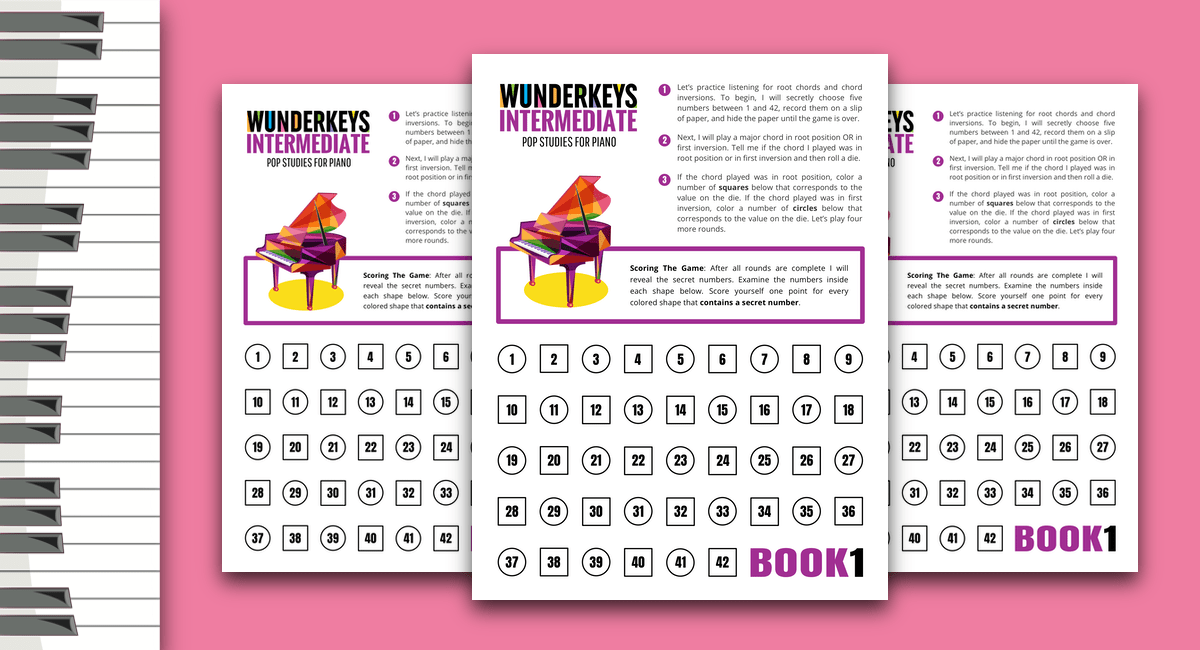
What do you mean by “a number of squares or circles? What number?
The number that corresponds to what you rolled with the die 🙂
It sounds like you have some great plans for incorporating fun and engaging theory-focused activities and ear training games for your intermediate students. It is true that making lessons fun and enjoyable is important for keeping students engaged and motivated, particularly as they get older. By dialing back the seriousness and incorporating enjoyable games and activities, you can help make piano lessons more fun and engaging for your intermediate students. This can help keep them interested in learning and playing the piano, and can also help them improve their skills and understanding of music theory. Well done on making it your mission to make piano lessons more enjoyable for your intermediate students!