
A 30-minute piano lesson can feel as though someone pressed fast-foward on your clock. Exam prep, recital prep, method book work, technical work, composing, piano games…
… and often it’s piano games that get left behind.
But wait! What if we told you that using piano games in your lessons will actually *save* you time?! How?
When children learn new concepts or review past concepts within the context of a game, they are fully engaged in the process. No time is spent re-directing, re-motivating or re-focusing… you have an eager learner beside you ready to soak it all in! Plus… your piano student will retain information more easily when it is presented in a game-based context because he is completely engaged in the process: he wants to win the game!
Keep reading to find out how you can easily incorporate piano games into your lessons… even when time is tight.

Make Time For Games With These 5 Strategies
So… there it is… the one hurdle to including game-based learning regularly is TIME. Fortunately, you can use a couple of simple strategies to crush that hurdle, and pave the way to studio success…
1. Easy Peasy Method Book Notes
I believe so strongly in using game-based learning, that before I send a student home with a new method book, I first add some of my own notes to the header of each piano piece in the book.
In the header (in a discrete area and in a tidy way) I write down the names of one or two piano games that reinforce the concepts being learned in the piano piece. Along with the title of the game, I also note the bin number where it is stored for quick reference (more on that later).
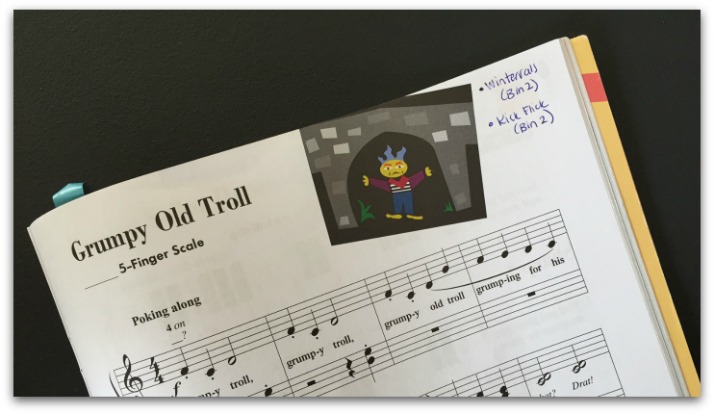
By doing this in advance, I eliminate any time spent deciding which is the correct game to use and then searching through my storage bins to find it. And because the information is directly written on the piano piece that is already open on the piano, it also eliminates the time I might spend opening my teaching binder and referencing a spreadsheet… every second counts!
This strategy requires a bit of prep work, but if you only use two or three method books, you quickly remember which piano games go with which pieces and making the notes before sending the method book home is easy-peasy.
2. Piano Game Days
The first time you play a piano game, you are bound to spend more than 5 minutes learning how the game is played. But once your kids know the rules, playing that game in future lessons takes a fraction of the time.
Because of this, you might want to consider hosting a Piano Game Day one weekend every month or two. During this day, you can teach your piano students how to play all of the fun new games you have.
Then, when your students come for their regular individual lessons, they are ready to roll and no time is wasted learning the games.
Piano Game Days are also a brilliant way to add to your teaching income and to help your piano students meet other music-minded friends, hereby building a sense of community.
3. Game Storage
You’re probably also wondering how to store your piano games so that you can easily grab exactly what you need… and spare yourself from a chaotic studio where spare dice cause tripping hazards and game boards and cards spill from every shelf.
So, I’m going to let you in on my game-storage secret!

As you see in the photo – each of my games has its own folder. Here’s how I set up all of my game folders:
1) Purchase “2 pocket” folders (at the Dollar Tree – 2 for $1.25)
2) Tape the (included) game cover page to the front of the folder.
3) Place the game board in the right-hand side pocket
4) Place the game play instructions in the left-hand side pocket
5) Contain all playing cards, die and game markers that are needed for that specific game in a ziploc bag that is then tucked into the left-hand side pocket.
Store your games in an open basket or bin so you can see the title labels easily, and separate your bins according to learning outcome. I have bins labelled as “1: Rhythm”, “2: Note Reading”, and “3: Ear Training” to name a few. Larger game items (chalk, balls, percussion instruments etc.) go in a bin with a lid… learned that lesson the hard way 😉
With this system you can find the exact game that works to reinforce your lesson focus, have everything you need to play immediately at your fingertips (including instructions if needed), and know exactly where to find each game folder.
4. Take-Home Piano Games
Reaping the many necessary benefits of game-based learning does not only need to happen during a piano lesson!
Consider creating Take-Home Game Bags that your students can check out and take home every week. This is a great strategy for reinforcing lesson concepts AND, what I consider to be even more important… getting parents involved in home practice!
If you choose to become a PianoGameClub member you’ll have new games every month to make a program like this a smashing success!
My Final (And Most Important) Strategy… errrr Philosophy
Truth be told I believe there is ALWAYS time for piano games.
I came to realize this when I started to think of them not as games, but as teaching tools. Then, suddenly, game-based learning became much more than a brain-break… it became a philosophy.
And this philosophy is guided by one very simple question:
“Can what I am about to explain be better off learned with a piano game?”
By adopting this philosophy, you’ll discover, as I did, that there is no need to “make time” for piano games. Piano games become a necessary component of any lesson, and a necessary tool that results in better understanding and increased motivation.
Get A FREE Piano Game!
Now for the best part… we have a great soccer-themed piano game to send your way that will improve bass clef note reading! All you have to do is share with us in the comments below one little time-saving tip that you use to help make the most of your precious piano lesson minutes.
And remember… everyone who leaves a comment will receive the game (Kick Flick) by email 🙂
Thank you for all the help you have given me.
I use games constantly in my classes and find it good especially when a child comes in a bit distracted from things that have happened at school.
Thank you for all the help you have given me.
I wrote a comment and an answer said I had already said the same thing before of which I do not recollect.
I like using the Alfred color-coded flashcards ( a new addition to my studio) to aid in learning. I have been working through piano pieces first and then leaving time at the end of each lesson to work through the cards. Although, note review has been done I’m realizing how much more time I need to be spending. Even students who seem to play their pieces very well, and know the notes in the pieces they are working on, still don’t always know their notes when seen individually on a staff. This flashcard method doesn’t really save time but it has become so necessary to me in the last couple of weeks. It may not save time in every lesson but it saves time in the long run as students become more and more familiar with their notes and in turn will become better sight-readers–it’s so important.
— I will say I haven’t tried doing this with every student but little by little, I’m introducing this method more and more.
I used to use games when I taught group lessons. Now that I’m teaching privately again, I haven’t used them because I feel I won’t have enough time to fit in everything else. However, I’m willing to give games a try again. Thanks
I use the timer on my smartphone to set the length of the lesson, minus 5 minutes (for general conversation). Instead of setting the timer for the length of the lesson, I set it for 2/3 of the lesson time. When the timer goes off, I know it’s time to play a game. That way I make sure I have game time.
I’m new to your site and love seeing everyone’s ideas. Having everything set up before students arrive is my “timesaver. My whiteboard activity is always interactive with me at the end of the lesson. Table games are done before lesson; older students are on their own; young students do all their activities with me. Looking forward to some new games and great ideas.
I have students do theory books before or after there lesson time. They correct everything but the test. I look over each section briefly asking them a few questions to make sure they understand concepts. I also have them use ipad for note drilling.
Just signed up today! We love games and cant wait to develop an awesome library of games!
I’m just going back to teaching piano after about a 20 year break. I taught children’s choir all that time, but wasn’t able to take on piano students due to a long commute.
I am so appreciative of all your ideas. I’m getting very excited to be teaching piano students again!
I have mostly homeschoolers who play with my kids while I’m teaching a sibling. My time saving strategy is to meet them outside and walk the proper child in to the piano so we can get started. I will also have multplie children play multiple piano games at the same time.
I’m looking forward to signing up to receive your games!
One time saving tip is I use a template I have designed for lesson notes. At the end of the lesson I attach it to their “clip board”. The clip board is the size of a single page so is easier for them to access during the week.
I also shorten the ‘sticker choosing time’ by slowly counting to three. If they haven’t chosen by ‘three’, then I make the choice for them!
Each student is different. I try to plan accordingly.
I love your question “Can what I am about to explain be better off learned with a piano game?” That gets to the heart of how people learn best–experientially, through mental/physical play!
I let my kids practice on piano maestro on my iPad while I write their assignments. It’s hoping them play songs at a performance tempo while I do something that takes up time.
These are two things I plan to do. I’m just starting back up after the summer. 1. Have a listening challenge as the students walk into the room. Identify intervals, motifs, etc. I’m coupling up kids and between their individual lessons I have them do a music game together. This actually adds a little time to my schedule, but I think will have ‘time saving’ benefits in the long run as far as theory.
I keep shelves with games in baskets grouped according to music element being taught.
I complete each lesson sheet on my computer and send weekly to my student’s parents (I teach only a few students). To save myself valuable time in class, I highlight in grey any item NOT covered in the current lesson. Then I strive to cover those items next lesson. For my parents/students, new items are highlighted in “fucia” and “homework” is highlighted in “yellow.” Meaning of each color is explained at initial interview but also appears in a log at the bottom of each lesson sheet every week. Words of praise or special notice I type in blue.
I get my piano groups to get involved in “musical hangman” (the words have to be music related) for the last 5 minutes of their lesson- this encourages them to work on their creative problem solving side and to try to incorporate reading and writing skills into the game, plus they love writing on the whiteboard!
I have a spreadsheet with basic pedagogy/sequence info on it and I match activities and games to that sequence. When I plan each week for lessons, I simply match a game from that list to the concept I’m working on with a student. I then keep a list, by date, of which games I need to pull out and in what order. Works like a charm.
After reading lots of these posts I realize how much of a disorganized teacher I am and I look forward to taking some new ideas and making better use of my time this year, hopefully incorporating more games into my lessons. One time saving tip I do is print a page at the start of the year with all the dates of my group classes and possible performance opportunities throughout the year. Then I can quickly write in the song we have chosen to perform in each students file as the year goes on, making it easy to know what I am planning for.
I just try to work quickly! I need better strategies which is why I’m on here 🙂 I’d love to have this piano game and I’ll probably sign up for the game club. I already love the book club!
Preparation is how I stay efficient. I prioritize the learning goals for each lesson and write thoughtful lesson plans. The more thoughtful I am, the more I’m able to re-direct the focus, if needed, while responding to the student’s playfulness. I vote for lesson plans.
To save time, if there is a parent present at the lesson, I have the parent participate and write down the assignments. I also have the game I am going to use out of the bin ready to be used. This way I can see the game and won’t forget to play! I subscribed to the game and book club today! So excited to receive more games.
As a new teacher I am still figuring these things out… since I teach most often at my students’ houses, my car will often act as my portable piano studio. I would be curious to hear any organizational tips from other traveling teachers. I make sure to use a piano bag with many pockets, so I don’t have to waste time looking for a pencil or post-it notes. I also believe piano games are a valuable and fun teaching tool so I really look forward to learning from other teachers and collecting awesome games through Piano Games Club!
I am still learning what is the most effective organizational system for me! I have a master binder with all the info I need on students and repertoire selections, as well as a cabinet with materials sorted by type. Looking forward to incorporating more games and extra rep into my teaching!
To save time, I start the lesson with student input: first they play the item that they feel was most successful during their practice week and then we move on to the item they struggled most with.
So many ideas from reading the comments and Andrea’s posts! I feel like attending a big conference while still having a cup of tea. Lately, I use piano practice games like a game of 5piano guys: when the student works on a difficult spot he needs to practice it 5times perfectly in a raw. By doing this he moves one piece at a time five “guys” from left side of the piano to the right. “Guys” could be anything- I use japanese puzzle erasers. If he messed up, he needs to start over.
I have my students write the weeks assignments and notes as I am gathering their other materials… this allows me to complete 2 jobs at once. The students then remember the work to practice during the week more often and the lesson runs smoother:) thank you!!!
Love the ideas, I usually get a visual schedule ready before the lesson. the kids get used to it and they know they need to tick of the finished activity and may be get a sticker for it. This helps me and the kids keep On track and they take it home to remind them of what they need to do. I make it usually colorful and interesting. I also add some quick notes for the parents at the end if needed
Great tips here! Getting lots of fresh new ideas!
Love this blog!
A time saving tip I like to incorporate into my lessons would be, is having their lesson practice notes/practice schedule ready to go before their lesson. Save me time and we can get right into the lesson.
Like Angie, having their take home lesson goals ready before each lesson is a great help.
Hi Andrea! I´ll love to get this amazing games for my students too!
thanks !!
I like to be unpredictable with my students so according to how prepared they are the choose from a pile of game files on the topic or I have them make up a game. That’s our favorite.
I give my “next” student a heads up (i.e. 3 minute warning) so they’re ready to walk right in and begin.
This will be my first game. I’m so happy to try that!
This is my first game. A friend of mine has a lot and she seems to enjoy them. I can’t wait!
I love, love, love the games! Some favs: Billy Bendapillar, Panda Pit Stop, Cyclopstrich, Car Race One (can’t remember name, but it’s for note values), and many more!
I put each game sheet in a plastic sleeve, the cards, tokens in a ziplock sandwich bag, and then put it all in a gallon ziplock bag. and put in a 2 drawer file cabinet. I mark on the outside of the bag, the Name, Goal, and Materials needed. It makes life a wee bit easier!
I use the same basic schedule with each piano lesson, so I don’t wonder what to do next. I am looking forward to adding some games into the schedule!
My time saving tip: be prepared! I have planned out which activities/games and which new pieces I’ll introduce to the student before they show up for lesson. Now sometimes we have to adjust that depending on if they get stuck on a new learning topic or not.
I try not to plan too much for each lesson. Then I’m not stressed out feeling the time crunch, and the student isn’t stressed out because I’m not pushing him!
I’m enjoying TeachPianoToday.com. Thank you for being here! I’m curious to know how long your weekly student lessons last: 30 minutes? 45? 60?
First year to do lesson games. Where have they been all my life?! I scour the internet for game ideas. Thanks for the ideas. Storage has been an issue and I now have an arsenal of ideas.
First year as a piano teacher and loving the game based approach! My Students are loving it too!
Rather new to your site and love what I see. Please send whatever game or piece is up for grabs. I’ve been teaching a long time and love changing up things in the studio!
Like many readers I keep a Daily Planner/calendar next to the piano where I jot down reminders of what I need to prepare for the next lesson – technic, theory, supplementary pieces, arrange or purchase new pieces. All my music is organized alphabetically by category and level so I can pull it off the shelf quickly before I begin lessons each day.
Last year I had my first K-4 student. She had started in WunderKeys and I was so pleased at how quickly she was ready to learn to read music. She has enjoyed the new games that Andrea and Trevor have provided for us as teachers. Having success with her has given me courage to take on several younger students. They are so much fun ! I added 4 more students in the last 2 weeks. They come from other parents referral. I’m so pleased to find teachpianotoday, it has made a world of difference in my teaching. Thank you !
My students love games — I love games! It feels like we’re taking “a break” when, really, we’re not!! A few of my tweens have been struggling with motivation (and I’m at my wit’s end!). This has helped: when my struggling student begrudgingly enters, he (usually he) sees a white board with five activities listed. I invite him to decide the order of what we do by placing numbers 1-5 beside each activity, and — voila — the grouchy student is now a happy student! Not a new idea for many of us, but we all need a bag of tricks, don’t we?
I save time by using thin post-it-notes on the pages of each book we are working in so we can turn straight to where we need to be. I also begin each lesson by asking what they practiced for me that week. That way I am not making assumptions and we can move forward.
I want to try some of these piano games, but I don’t know if they will work for online lessons. I’m sure I could figure out a way to use some of the games this way. I use flash cards and playback for some games, but definitely want to add more. My time-saving tip is to have a pre-planned lesson plan written out and also go with the flow of the lesson. Then I look back at the plan and see what we can work on in the time that’s left.