
A 30-minute piano lesson can feel as though someone pressed fast-foward on your clock. Exam prep, recital prep, method book work, technical work, composing, piano games…
… and often it’s piano games that get left behind.
But wait! What if we told you that using piano games in your lessons will actually *save* you time?! How?
When children learn new concepts or review past concepts within the context of a game, they are fully engaged in the process. No time is spent re-directing, re-motivating or re-focusing… you have an eager learner beside you ready to soak it all in! Plus… your piano student will retain information more easily when it is presented in a game-based context because he is completely engaged in the process: he wants to win the game!
Keep reading to find out how you can easily incorporate piano games into your lessons… even when time is tight.

Make Time For Games With These 5 Strategies
So… there it is… the one hurdle to including game-based learning regularly is TIME. Fortunately, you can use a couple of simple strategies to crush that hurdle, and pave the way to studio success…
1. Easy Peasy Method Book Notes
I believe so strongly in using game-based learning, that before I send a student home with a new method book, I first add some of my own notes to the header of each piano piece in the book.
In the header (in a discrete area and in a tidy way) I write down the names of one or two piano games that reinforce the concepts being learned in the piano piece. Along with the title of the game, I also note the bin number where it is stored for quick reference (more on that later).
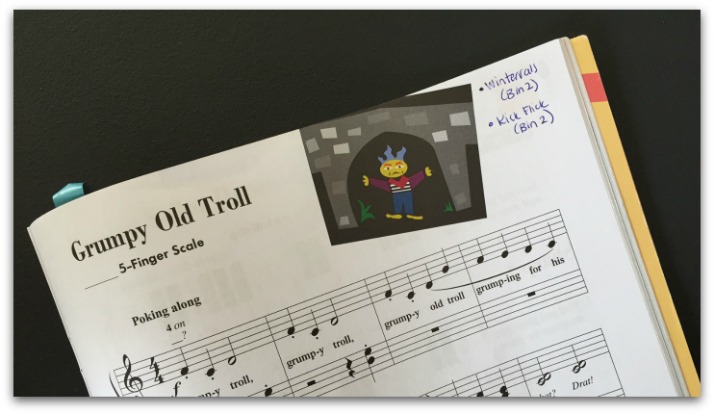
By doing this in advance, I eliminate any time spent deciding which is the correct game to use and then searching through my storage bins to find it. And because the information is directly written on the piano piece that is already open on the piano, it also eliminates the time I might spend opening my teaching binder and referencing a spreadsheet… every second counts!
This strategy requires a bit of prep work, but if you only use two or three method books, you quickly remember which piano games go with which pieces and making the notes before sending the method book home is easy-peasy.
2. Piano Game Days
The first time you play a piano game, you are bound to spend more than 5 minutes learning how the game is played. But once your kids know the rules, playing that game in future lessons takes a fraction of the time.
Because of this, you might want to consider hosting a Piano Game Day one weekend every month or two. During this day, you can teach your piano students how to play all of the fun new games you have.
Then, when your students come for their regular individual lessons, they are ready to roll and no time is wasted learning the games.
Piano Game Days are also a brilliant way to add to your teaching income and to help your piano students meet other music-minded friends, hereby building a sense of community.
3. Game Storage
You’re probably also wondering how to store your piano games so that you can easily grab exactly what you need… and spare yourself from a chaotic studio where spare dice cause tripping hazards and game boards and cards spill from every shelf.
So, I’m going to let you in on my game-storage secret!

As you see in the photo – each of my games has its own folder. Here’s how I set up all of my game folders:
1) Purchase “2 pocket” folders (at the Dollar Tree – 2 for $1.25)
2) Tape the (included) game cover page to the front of the folder.
3) Place the game board in the right-hand side pocket
4) Place the game play instructions in the left-hand side pocket
5) Contain all playing cards, die and game markers that are needed for that specific game in a ziploc bag that is then tucked into the left-hand side pocket.
Store your games in an open basket or bin so you can see the title labels easily, and separate your bins according to learning outcome. I have bins labelled as “1: Rhythm”, “2: Note Reading”, and “3: Ear Training” to name a few. Larger game items (chalk, balls, percussion instruments etc.) go in a bin with a lid… learned that lesson the hard way 😉
With this system you can find the exact game that works to reinforce your lesson focus, have everything you need to play immediately at your fingertips (including instructions if needed), and know exactly where to find each game folder.
4. Take-Home Piano Games
Reaping the many necessary benefits of game-based learning does not only need to happen during a piano lesson!
Consider creating Take-Home Game Bags that your students can check out and take home every week. This is a great strategy for reinforcing lesson concepts AND, what I consider to be even more important… getting parents involved in home practice!
If you choose to become a PianoGameClub member you’ll have new games every month to make a program like this a smashing success!
My Final (And Most Important) Strategy… errrr Philosophy
Truth be told I believe there is ALWAYS time for piano games.
I came to realize this when I started to think of them not as games, but as teaching tools. Then, suddenly, game-based learning became much more than a brain-break… it became a philosophy.
And this philosophy is guided by one very simple question:
“Can what I am about to explain be better off learned with a piano game?”
By adopting this philosophy, you’ll discover, as I did, that there is no need to “make time” for piano games. Piano games become a necessary component of any lesson, and a necessary tool that results in better understanding and increased motivation.
Get A FREE Piano Game!
Now for the best part… we have a great soccer-themed piano game to send your way that will improve bass clef note reading! All you have to do is share with us in the comments below one little time-saving tip that you use to help make the most of your precious piano lesson minutes.
And remember… everyone who leaves a comment will receive the game (Kick Flick) by email 🙂
I have so many of your games, Andrea – the new starters love Queen Bee (so much so, that even when they understand dotted crotchets/quarter notes they still want to play Queen Bee!) whereas the slightly more advanced pupils particularly enjoy Moose on the Loose. I always keep these games in a turquoise folder, so whenever the folder comes out of my back, the kids get really excited. I take the folder everywhere…
That’s awesome Sarah! Moose on the Loose is a favourite in my studio too 🙂
I just have to be very organized. If I have everything planned well in advanced, our lessons go better.
OMG! A Music Soccer Game. I think half my students play soccer here in the Adirondacks. They’ll love this one for sure. Yes, I, too, play a lot of games with my students. They enjoy having someone spend time with them.
When the student walks in and prepares the bench, etc., I grab the book bag and hand them my ipod with NoteSquish, Flashnote Derby, etc and they compete with themselves from last weeks’ score (posted on an awesome peel-able chalkboard from Coles) while I prepare the order of books and quickly mark the theory.
I am a new teacher, and trying to figure out how to best spend the 30 minutes that flies by! I like the advice from more experienced teachers about not stressing if you don’t get as far as you wanted. I am trying to master quickly but neatly writing their assignments and tips for students as they are playing their piece, but it’s difficult, I teach a majority of young students, and I feel bad if I’m not giving them 100% of my attention.
I print out the lesson notes sheet before the lessons, then write my notes, instructions, etc on it. Then run it thru the copier so I have a copy. I also have a folder for each student where I plan the lesson times, activities, etc. Any handouts, music, magazine, goes in the folder so I remember to give it to the student. Love the games!!
I have every game for the day ready to go (sometimes that 3 different ones) and it helps tremendously to save time. The better I plan – the better use of our 1/2 hour together.
I give my student a task that they can do by themselves while I write down their homework and also my lesson notes. Time flies but this way I am (mostly) able to fit in revision, games/activities and new material as well as a chat about how to practise it. However, if a game or song proves particularly productive I sometimes let go of the lesson goals and spend more time on that instead.
Can’t wait for new games to add to the repertoire! Also, thanks to your tip I am off to buy some 2 pocket folders today – all the games are currently spread out over our ‘games’ table, which makes it tempting for kids to pick their favourite game instead of doing the one most suitable to the lesson!
I have students play their scales and exercises while I mark their 2 pages of theory. (they are not allowed to do more than two pages to save me time and it also helps with retention as those who do many pages at a time don’t remember come test time what they learnt. – not to mention it costs a fortune in worksheets or books!!). I also in some lessons have parents take notes instead of me.. This only works for some families though.
If time is running short and we are learning new material, I head straight to the tricky spots and do only those if I feel the students can handle the rest of the piece on their own.
I take a few minutes each week to jot down notes on my iPad about what concept I’ll be covering the next lesson and which game to use for each student. The following week I go down my list for that day and put the games listed in my bag ready to go (I teach at students’ homes.) My games are organized by category at home in an expandable folder so I can quickly find the ones I want.
i save time by having a lesson plan outline for each day/each student within close range to keep on track. I can quickly cross things off or write a quick note to myself for things that we didn’t get to so that I can adjust the next week’s plans.
I love the idea of writing the name of reinforcing game in the method book!
I created a lesson plan sheet with a space for notes for next week. That way I can go there first when planning and remember what didn’t get covered the week before.
Thanks for your tip on marking up method books. I am finding that my students look forward to that game time of the lesson and are responding, learning and accelerating wonderfully!
I plan ahead for my lessons and make sure there’s more than enough to cover. That way, there’s never a time where I’m trying to figure out how to finish up the last few minutes. 🙂
I love the idea of sending the games home! Brilliant! I use (typically your games because they’re the best) weekly. Our whole Studio and all of the teachers have a game, or activity from PSST Series ready and waiting at the start of each lesson. In fact, we seldom even open the theory books that accompany the lesson books. I also take advantage of holidays, Halloween right now, to introduce modes. Our Studio is learning at least 5 of their favorite songs in the minor key…..and they come to lesson with lots more than 5 learned! Thank you…..retention is much better and parents report excited kids on lesson day 🙂
I correct the students’ music theory books while they warm up with exercises and scales.
Also, because of the fun and increased retention the majority of parents are receptive to 45 minute lessons, even for beginners……and WOW, has this made a difference!
Keep a spreadsheet of all games in the studio. Can categorize by take-home, in -studio only, etc. Each child keeps the games spreadsheet in their piano folder/binder. As games are played and completed they are checked off. You can also create game spreadsheets by piano level. So the games are listed on the same spreadsheet that lists the level expectations you have.
What wonderful organizational ideas. I bought a shoe holder with many pickets for a lot of my games. I then bought a see through jewelry storage holder so I can see separate card games etc. I love the folder idea for the games I have that have boards.
I love using sticky notes. Any thoughts I have on a student I jot down quickly and stick on a folder. At the end of the day these notes serve as a reminder of what I need to do before the next lesson. When it’s done, I throw the note away.
Love your organization ideas. Thanks a bunch.
I try and have all of my lesson and theory books open to the pages we are working on the night before. I also have my game ready to use and stick it in whenever the student is losing focus. – which is often.
thank you so much for these great games.
Time-saving tip: I put my students’ lesson plans on a 3×5 card so I don’t have to flip through books to figure out what needs to be done next. It is all laid out in the order I plan to present it.
I try to have the game(s) already picked out before lessons start.
If I’m playing a game at the beginning of a lesson then I will put a timer on or stop at a convenient point promising ‘to come back at the end if there’s time’. The kids are happy to start the lesson and I’m happy to have covered a concept. Often there isn’t time (and I know this) but we promise to play again next week and they go on their way with a smile on their face.
I use the colored folders that correspond to the Faber lesson book they are working in. ex.) games corresponding to My first piano adventures-yellow book in a yellow folder…level 1 red in a red folder… And I keep all the holiday games in the various levels in the file cabinet until it’s the right season. I rotate games to keep them fresh.
LOVE your idea of writing the games in the lesson book!! Genius!
I use sticky notes with practice steps on them and put them on the pieces they are working on. I also prepare a sticky note before the student’s lesson with what I’m planning to assign that day and I put it on my fall board so I don’t forget something and so I don’t have to go to the student’s folder. I can quickly glance at the sticky note as we progress through the lesson.
I set a timer, so that we only spend an allotted time on each activity
I have used the TCW games for years in group classes but hadn’t thought of using games in individual lessons. Now I am excited to incorporate this into lessons. My time saving tip is to star the things I will hear first at the next lesson. This way, the student and I both know what I will ask for. I avoid the situation of using an entire lesson on a piece and then finding out the student worked more on something else.
I love reading the time management tips! Games are definitely making a difference for my students. My helpful tip, I put siblings to work cutting and gluing game cards to card stock for durability. They love music craft time and they get a sneak preview time to practice rhythms and notes!
I keep a steno pad by the piano and write pieces, games, technic – whatever is needed for the next lesson. So my notes are in the order the students come and after lessons, I am able to get everything ready for the following day based on last lesson’s notes.
I have a photocopy of their songs and draw little symbols on with a different colour each week. That way I’m not writing an essay in their notebooks while trying to listen and I don’t forget what I wanted to talk about.
They also get pencils to write what I’m saying on their music: pull back on tempo becomes a backwards arrow, notes that need emphasis get hearts on them, lines are drawn in to follow phrases, eyeballs are added at the end of lines to remind them to look ahead. That way they have my notes with them while they’re playing the piece, rather than digging out a book/binder, reading, and trying to remember what I said while playing the piece.
Of course, I did “borrow” that idea from my piano teacher!
Here’s the thing..I don’t like having to scroll through 800 messages to find a place to add mine, in order to get a free game! That’s not saving my time!
Each assignment is written out on a duplex paper, that is a white Copy on top the student takes home, and a yellow copy on the bottom for my records. I review their assignment before their lesson, and fill out as much as possible the next weeks lesson in advance. Each student has a Manila file with their name on it, with ideas for next pieces in it. Also, I try to tell myself to relax, and enjoy the Lesson, and not to cram so much stuff down their throats. It is not all important, every week!
Each student’s assignment is a Word document which I revise before each lesson, then make final changes during the lesson. It’s printed and placed in the front of their binder, while my file is saved under the lesson date (yyyy.mm.dd) in that student’s folder.
Thanks for your organizational tips. What a great idea to write the name of the game in the student’s new book.
We play games at the start of the lesson. Besides being a teaching tool the games are fun and help build rapport with students.
I use sticky tabs to help the student find their place in each book they bring to their lesson. They keep their sticky-ness for quite a while.
I gave up method books a few years ago. Don’t get me started on how ridiculous it is to juggle 4 books in one lesson. Instead, I have found numerous websites– some free, some subscription, and printed out music. This is how I found this website, which is the best yet. I now have at least a couple dozen binders of music. The master copy and a few copies are in plastic sleeves, arranged in progressively harder order. Some binders are Christmas, Halloween, Irish music, etc. I make a binder each month of Andrea’s book of the month. Games will be put in plastic sheets in the binders with related songs. I’ll probably set up game binders as well. By the way, since giving up method books, my retention rate as gone through the roof. (I charge parents $50/year for materials.) These games will make it even better!!
For keeping up with where each student is in their method book, I created a form with each song or piece listed and have one for each student. At the end of the lesson I date the ones completed and circle the ones they are assigned for the week. At a glance I know where they are and can see how fast or slow they are making progress.
My students are teens or adults. To save time, they know to immediately sit down and begin playing their technical exercises and scales as I am transitioning into their class time with materials, books, etc. or need to leave the room for a moment.
This year I am saving time in my student’s lesson notes by using a template with headings that I trace in their spiral note books each week. Then I quickly jot in my comments and homework etc.
Games cause added cooperation from children. After a game they are more willing to move forward and there is better interaction which is helpful to all.
My lesson notes are online. As we go over the pieces I note items to go over the following week in red italics. They are ready for the following week.
My piano students say “Thank you!” And so do I!
I always go over theory with students before they take home their work. Going over unit tests helps them “see’ the important words – like “use whole notes” or “treble clef.” I like to make sure they’re going to get 100 percent. Reminding them to double-check their work should also help them spot small errors.
I used to try to cover too much in one lesson but I have learned that “less is more”.
Games have always been a part of my teaching and will love to see your new ideas and games for me to add to the learning happening in my studio.
I write notes during lessons for things that I need to get done/print/find for the student for the next week. I try to go through my notes at the beginning of each week before lessons start and get all the tasks done. At the latest, I look at my schedule the night before and make sure I have everything that I need for the following day.
Pre-printed practice sheets. For 13 years I wrote everything out by hand. Not this year. It’s been great!