
A 30-minute piano lesson can feel as though someone pressed fast-foward on your clock. Exam prep, recital prep, method book work, technical work, composing, piano games…
… and often it’s piano games that get left behind.
But wait! What if we told you that using piano games in your lessons will actually *save* you time?! How?
When children learn new concepts or review past concepts within the context of a game, they are fully engaged in the process. No time is spent re-directing, re-motivating or re-focusing… you have an eager learner beside you ready to soak it all in! Plus… your piano student will retain information more easily when it is presented in a game-based context because he is completely engaged in the process: he wants to win the game!
Keep reading to find out how you can easily incorporate piano games into your lessons… even when time is tight.

Make Time For Games With These 5 Strategies
So… there it is… the one hurdle to including game-based learning regularly is TIME. Fortunately, you can use a couple of simple strategies to crush that hurdle, and pave the way to studio success…
1. Easy Peasy Method Book Notes
I believe so strongly in using game-based learning, that before I send a student home with a new method book, I first add some of my own notes to the header of each piano piece in the book.
In the header (in a discrete area and in a tidy way) I write down the names of one or two piano games that reinforce the concepts being learned in the piano piece. Along with the title of the game, I also note the bin number where it is stored for quick reference (more on that later).
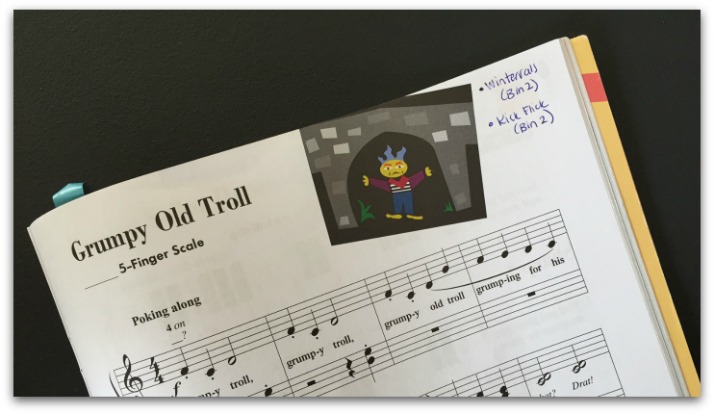
By doing this in advance, I eliminate any time spent deciding which is the correct game to use and then searching through my storage bins to find it. And because the information is directly written on the piano piece that is already open on the piano, it also eliminates the time I might spend opening my teaching binder and referencing a spreadsheet… every second counts!
This strategy requires a bit of prep work, but if you only use two or three method books, you quickly remember which piano games go with which pieces and making the notes before sending the method book home is easy-peasy.
2. Piano Game Days
The first time you play a piano game, you are bound to spend more than 5 minutes learning how the game is played. But once your kids know the rules, playing that game in future lessons takes a fraction of the time.
Because of this, you might want to consider hosting a Piano Game Day one weekend every month or two. During this day, you can teach your piano students how to play all of the fun new games you have.
Then, when your students come for their regular individual lessons, they are ready to roll and no time is wasted learning the games.
Piano Game Days are also a brilliant way to add to your teaching income and to help your piano students meet other music-minded friends, hereby building a sense of community.
3. Game Storage
You’re probably also wondering how to store your piano games so that you can easily grab exactly what you need… and spare yourself from a chaotic studio where spare dice cause tripping hazards and game boards and cards spill from every shelf.
So, I’m going to let you in on my game-storage secret!

As you see in the photo – each of my games has its own folder. Here’s how I set up all of my game folders:
1) Purchase “2 pocket” folders (at the Dollar Tree – 2 for $1.25)
2) Tape the (included) game cover page to the front of the folder.
3) Place the game board in the right-hand side pocket
4) Place the game play instructions in the left-hand side pocket
5) Contain all playing cards, die and game markers that are needed for that specific game in a ziploc bag that is then tucked into the left-hand side pocket.
Store your games in an open basket or bin so you can see the title labels easily, and separate your bins according to learning outcome. I have bins labelled as “1: Rhythm”, “2: Note Reading”, and “3: Ear Training” to name a few. Larger game items (chalk, balls, percussion instruments etc.) go in a bin with a lid… learned that lesson the hard way 😉
With this system you can find the exact game that works to reinforce your lesson focus, have everything you need to play immediately at your fingertips (including instructions if needed), and know exactly where to find each game folder.
4. Take-Home Piano Games
Reaping the many necessary benefits of game-based learning does not only need to happen during a piano lesson!
Consider creating Take-Home Game Bags that your students can check out and take home every week. This is a great strategy for reinforcing lesson concepts AND, what I consider to be even more important… getting parents involved in home practice!
If you choose to become a PianoGameClub member you’ll have new games every month to make a program like this a smashing success!
My Final (And Most Important) Strategy… errrr Philosophy
Truth be told I believe there is ALWAYS time for piano games.
I came to realize this when I started to think of them not as games, but as teaching tools. Then, suddenly, game-based learning became much more than a brain-break… it became a philosophy.
And this philosophy is guided by one very simple question:
“Can what I am about to explain be better off learned with a piano game?”
By adopting this philosophy, you’ll discover, as I did, that there is no need to “make time” for piano games. Piano games become a necessary component of any lesson, and a necessary tool that results in better understanding and increased motivation.
Get A FREE Piano Game!
Now for the best part… we have a great soccer-themed piano game to send your way that will improve bass clef note reading! All you have to do is share with us in the comments below one little time-saving tip that you use to help make the most of your precious piano lesson minutes.
And remember… everyone who leaves a comment will receive the game (Kick Flick) by email 🙂
thanks again for your great ideas!
My “time-saving tip” maybe sounds off the topic, but I remind myself every single lesson to not feeling stressed.
Saying to myself “I´ll enjoy every minute of this lesson, I don´t have to teach everything in every lesson, I´ll go with the flow” combined with being well prepared for every child makes all the difference for me.
Love your free games.. Thanks for sharing.
I decided it was time for some Halloween fun, and this week the FIRST thing I’ve done as each student arrives is play a Halloween game from my file that will benefit them through the rest of the lesson. The kids have been so surprised! Then they break into a smile and say “OK!”
My time saving tip is simple: be organized and have a plan ready for each student. I’ve also found its helpful with very young students to hide games/activities etc we will be using until its time to play them, or they are a distraction!
I just found your site and I am thrilled! One game my students love is Beat The Clock, with a dry erase board. I put notes and symbols they have to guess and then they get 3 trys to beat the clock. They earn a music dollar for every time they beat it and get to spend their dollars at the music store.
Hi Sue – welcome to our blog! Looking forward to connecting with you 🙂
love these ideas – can’t wait to see what else is coming up!
My time saving technique – I use my computer to take notes during the lesson. After the lesson is over and the student is gone, I edit the notes and the assignment and email it to the parent, who can print out a hard copy for their child. They see my assessment notes, my practice notes, and the child’s assignment when they print out a hard copy. Saves time during the lesson.
Love these ideas! I usually save the last 5 minutes for learning based games. They love it. I use a 3-ting binder for game boards and plastic drawers for game pieces.
I have my students pick out the stickers they have earned while I am writing down their assignment.
I usually save a little time every lesson by having the games I plan to play already in my piano bag, I teach mostly at my students homes, so I have most of the games in there and when I need one I take it out right away 🙂 If you have any advice on how to be more effective with games etc when you can only bring a bag at your student’s place, I’d LOVE that!
Hi Sylvia!
I also teach at my students homes. One of the best tips I have is to use standard flash cards that can go with a lot of your games (eg a set of key cards, a set with base clef notes, a set with treble clef notes, a set with symbols, etc.). Most of these can be found for free online (most of mine actually came with a specific game, but work across the board). I keep a card file of flash cards in my bag, and I keep game boards in sheet protectors in my binder. It saves a lot of space and let’s you have all of your games at your fingertips every lesson. (I’ve used an accordion file for game boards in the past, and that worked well too)
Thank you for the great ideas, particularly the organization ideas. I don’t use enough piano games and need to do more.
Great ideas on how to incorporate the games! I need to organize them better and this definitely will work!
My time-saving trick for exam students is creating simple spreadsheets on my iPad of technical requirements for each grade. After each scale, arpeggio, triad… is completed I change the background of the cell to green (excellent), yellow (so-so) or red (not good). I can quickly see at a glance which ones need drilling & then change the colour accordingly.
I left a comment last time but did not receive the rabbit ribit game. Hopefully this time I will get the soccer game. Thx for this process, just reading all the replies is an efucatop. Of its own making!
Hi Dens,
Just emailed you the Ribbit Rhythms again 🙂
I try to write notes on the new pieces as we go as well as notes in their practice plan. That way I know they have everything needed to successfully practice at home without having to ‘make sure’ they remember by repeating myself. They have it written down and we can move on!
I really like your ideas Andrea and you always address the practicalities too 🙂
I often have a one minute challenge theme in a week – so this week it is some halloween counting / maths activities – all presorted & laid out with the stopwatch ready to go the second the student hits the piano bench – it charges them up!
One tip I remind myself is: the acquisition of piano skills is a journey and even lifetime to acquire. I do my best each lesson in teaching material, but I don’t stress if not everything is caught the first time around!
My time saving tip…figure out a routine or basic outline of events that happen in the lesson time. This way you are always one step ahead. But remember this can be changed around sometimes! I also like to train my students to “prepare for piano”. When they arrive for lesson time do this: books ready, bench ready, I’m ready!
I keep the page of each theory book marked with a clip so I can simply hand it to the student when it is time for theory work. The theory books are open, ready to go, in the correct teaching order the day. When theory is finished, the book goes to the bottom of the pile, ready for next week.
I used to feel like we need to play through everything that I’m going to assign for the following week in lesson. Lately, I’ve been trying to remember that sometimes it’s good to go over the new concepts and tricky sections in a piece in lesson, but send the kid home to figure out the rest on his/her own. Not only does it make more time in the lesson, but it encourages independent thinking in the students when I don’t spoonfeed everything, and increases their confidence when they succeed.
I’ve been doing this more and more lately too! It’s helping my students become less dependent on me to explain the whole piece to them.
Less instruction – more game play – equals faster learning
I 100% agree that using piano games motivate my students. They come to each lesson anticipating what the next game will be! When reinforcing a concept, I am also able to reference a game we played together, and a light bulb immediately goes off in their head. A wonderful way to make the connection between theory and their assigned piece!
If I have a game planned, we do it right at the beginning so I don’t run out of time.
I file all of my games alphabetically in a file with pockets in… The ones I haven’t played recently go on the top of the pile so that I can keep track of which ones are new and which ones we have already used. Looking forward to your next tips!
I have a list for each child stating what I hope to cover in that lesson. I have the materials per child laid out in a little pile ready for use. The game is essential for me. I’m learning that the fun factor is hugely important. If the child leaves my studio smiling and on a high then I know he/she will think positively about piano and everything associated with it. I’m also learning not to panic if we don’t get through the material I hoped to. It’s a journey!
My tip is to have the folders as you describe in #3 above but have the folders be different colors for the different levels. That way they are easy to get into the correct bin when it’s time to put them away and one less thing to have to read on the label. Love the #1 idea. Simple. Brilliant!! Thanks!
My time-saver is more mental — before each lesson starts, I tell myself that whatever we accomplish is progress. We may not complete everything, but at the end, the student will know more than he/she did when they began that day.
I have an app where I quickly notate their next week’s assignment. It takes a minute–while they are warming up on a piece, or pulling out another book–but saves precious time in the next lesson as I have reviewed what is coming up in the lesson before they arrive. I know what concepts I will present, what games we will play, etc.
Andrea, is it a specific app or do you use notes or something along those lines?
That’s a really good idea, Andrea. I always have my cell phone handy, so I could just open up my “memo” app and wrote notes for the next week’s lessons. Thanks!
I love your ideas and am looking forward to implementing them! Remembering you don’t have to accomplish it all in one lesson. Enjoy the journey!
This is wonderful!!
What I do to save time is have a pre-planning session for each week. I teach every day of the week (weekends off), so I created a folder for each day. In the folder, I have a lesson plan on a spreadsheet for each student of that day. I write down what each student is learning and I print off activities and theory resources and place them in the folder. In the morning, everything is ready to go for the day and I feel confident and prepared for each student that day. During the lesson, I have the spreadsheet on a clipboard and I make notes about the student during the lesson. This helps me keep track. Can’t wait to start adding games!
I leave a note at the bottom of my students’ weekly practice plan to remind me of specific games/theory activities I want to cover in the lesson the next time I meet with that student… Also generates some eager anticipation for the student as well. (“Next week we get to start Muzzart and Ratmaninoff!”) –LOVE Muzz and Rat, BTW!!
Students have their books in the assignment order – saves time to go through the lesson and they post their stars on the star chart themselves!
One time saving skill I have is not during lessons but prior. I write down what my students are doing and then I can prepare what activities I need to have ready for them before the next class. I also use a white board- type handout for assignments so I don’t have to always print a new one each lesson.
I just wanted to thank Andrea, Trevor and all the teachers who post here. I feel like I’m becoming a better teacher because you all share your ideas. Thanks!!
Before lessons begin, I already have the games out and ready for when the students arrive, mindful of which concept needs to be reviewed by each student. They are excited when they see a game ready before they sit down.
Some of my younger school-age students come almost straight from school and aren’t always in the mood for serious concentration at the piano on something they “forgot” to practice. When I see this at the beginning of a lesson, I say “let’s play a game.” After five minutes of a game, they are much more ready to play the piano.
Good sdvice, Diana. We will get ahead more quickly when we can work with students from where they currently are (mentally as well as progress-wise).
Those videos are so cute. Thank you for your great ideas for storage too. And marking the books. You’re right, I’m sure I will quickly remember which games go with the songs I do routinely. Thanks!
most of my parents come to lessons so I save time by getting them to record the work required at home during the lesson…this way they also know what is required
I keep a yellow pad on a clipboard by my piano. When I realize I need to do something for a student before the next lesson I jot it down and have it ready for them the next week.
I just remember that you don’t have to do it all in one lesson. If you don’t get to something this week, you can do it next week. Also, just checking theory and writing notes and assignments while they’re working on flashcards or method books.
Very helpful will be writing game options of each piece on my master copies of the method books. Thanks for the tip!
If they have a theory page to do, and we don’t have time to finish it in class, I do one or two problems with them and let them finish the rest at home.
Always on the beginning-piano games are educational as well, so no stress! 🙂
Whenever we play games, I make sure that we DON’T pack up afterwards, so as not to waste any lesson time!! I am happy to do the packing up at the end.
Thanks – I love all games as they help with challenges. My time saving tip is to get the students to put their repertoire/books into the order they want to play them each week, (they must choose different order each week) before they arrive. We save time in the lesson working out which to play first. We have up to 4 different things to play, plus games. They love the games and only get to play them in the lesson when they have practiced well during the week – their reward so to speak. It works for me as they like games to be part of their lessons.
I give them homework with specific challenges and they get to take home a game to practice that challenge when they listen respectfully in the lesson. I do expect a lot from my students and thankfully they love to learn. I am lucky to have a great bunch of students!
I agree games are important and finding the time is hard but I will give it a try.
It is absolutely amazing how games reinforce a concept you have continued to teach. The student struggles and struggles, then had a game and wow! they seem to pick it up. Thanks for your help.
I happen to have a lot of siblings that come for back to back lessons. This is great for me because I can “double up” and have them play games against each other, which takes less time than playing individually.
I do the same! Their competitiveness really works in my favour 😉
I’m playful with my kids. Sometimes, the kids don’t know when to buckle down, which can lead to wasted time, so I have my “serious face”. I tell them I’ll continue to have fun, but when the serious face comes on, it’s time to work. So far, so good!
I asked a much more experienced teacher to critique my work. Her wonderfully simple observation was “Less talk, more music.” I can not tell you how many times I have said it to myself through the years.
That is something I try to remember, also! There’s SO MUCH I want to tell them and to know, but playing the music will tell them more!
I have an adjustable piano bench that has numbered notches for each height and stackable footstool for heights in 1-inch increments between 2″ and 17″. At the first lesson of the school year, I find the best height of each for each student and write it on a chart that I keep on my piano. While I am seeing one student out the door, the next student (or his parent) adjusts the bench and stool to the correct height and takes out lesson material so he is all ready to go by the time I sit down. During the course of the year, when the knees approach the nose, I know it is time to make another adjustment!
I love the idea of writing the name of the game right in the lesson book! Here’s my little time-saving tip: instead of having the student choose a sticker for each completed piece in the method book, I now have 3 self-inking stamps from which to choose. (I used to use stickers – and some students can take a very long time to choose just the right one!) A limited choice – and a stamper instead of a sticker – is much faster!
Donna, that is such a great idea! I’m going to steal it! 😉
There’s always time for games! I use them as a reward when a student really impresses me. I find they work just a little harder knowing they’ll get a great new game to play!
I use the “notes” app on my iPad to list idease for each student’s lesson for the week and divide them by day. So today I will open the note calle “Wednesday students” to recall what I would like to reinforce with each student.
I have a display folder with a page for each of my students in it, the cover of each page is a sheet with two columns – the first a lesson plan and the second notes on what we achieved in the lesson and any notes on what happened in the lesson and things to work on. Then behind this sheet I put all the music/sheets etc. that I need for that student for the coming weeks. Make it really easy and quick to check to remind myself what that student is up to/doing in that lesson and I have all my materials ready right away! I also use accordion folders with labels at the top to store all my games, its a really easy way to store and organise all my games without taking up too much space.
One time saving trick I do is prepare a monthly plan with all activities and challenges listed. I have a list of musical elements to be covered within the year for each student and when I feel like they fully understand that concept, it gets checked off on their sheet. The one thing I have to do now is organize my games. I love the idea of the folder system!
I have big bird clips I attach each child’s work for that day. When they come in they grab their “bird” and get to work. I overlap lessons so one child is doing their theory work while the other student is finishing up their lesson with me. The more I prepare ahead of time the smoother lessons run. Duh!
Thanks so much for sharing your precious ideas – I feel like Im in a whole different world.. I have enjoyed your tips and cannot wait to apply them in to my lessons. Sometimes teaching feels tiring but I feel very different this time, so I really would like to thank you.
I have a giant keyboard that I made out of a window shade and black tape. I have the student toss a quarter and wherever it lands they have to name the note and then go find it on the piano as well.