
A 30-minute piano lesson can feel as though someone pressed fast-foward on your clock. Exam prep, recital prep, method book work, technical work, composing, piano games…
… and often it’s piano games that get left behind.
But wait! What if we told you that using piano games in your lessons will actually *save* you time?! How?
When children learn new concepts or review past concepts within the context of a game, they are fully engaged in the process. No time is spent re-directing, re-motivating or re-focusing… you have an eager learner beside you ready to soak it all in! Plus… your piano student will retain information more easily when it is presented in a game-based context because he is completely engaged in the process: he wants to win the game!
Keep reading to find out how you can easily incorporate piano games into your lessons… even when time is tight.

Make Time For Games With These 5 Strategies
So… there it is… the one hurdle to including game-based learning regularly is TIME. Fortunately, you can use a couple of simple strategies to crush that hurdle, and pave the way to studio success…
1. Easy Peasy Method Book Notes
I believe so strongly in using game-based learning, that before I send a student home with a new method book, I first add some of my own notes to the header of each piano piece in the book.
In the header (in a discrete area and in a tidy way) I write down the names of one or two piano games that reinforce the concepts being learned in the piano piece. Along with the title of the game, I also note the bin number where it is stored for quick reference (more on that later).
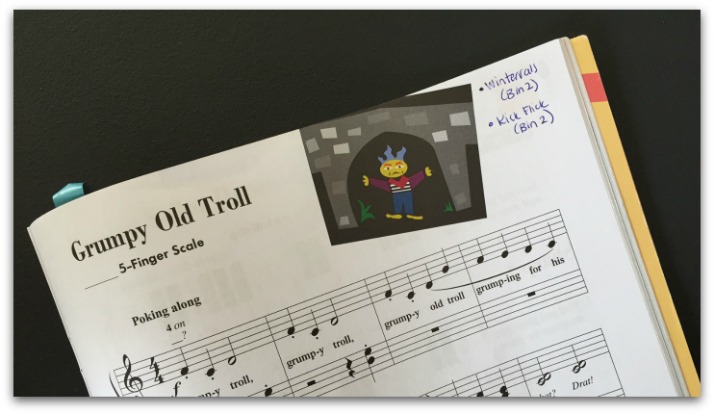
By doing this in advance, I eliminate any time spent deciding which is the correct game to use and then searching through my storage bins to find it. And because the information is directly written on the piano piece that is already open on the piano, it also eliminates the time I might spend opening my teaching binder and referencing a spreadsheet… every second counts!
This strategy requires a bit of prep work, but if you only use two or three method books, you quickly remember which piano games go with which pieces and making the notes before sending the method book home is easy-peasy.
2. Piano Game Days
The first time you play a piano game, you are bound to spend more than 5 minutes learning how the game is played. But once your kids know the rules, playing that game in future lessons takes a fraction of the time.
Because of this, you might want to consider hosting a Piano Game Day one weekend every month or two. During this day, you can teach your piano students how to play all of the fun new games you have.
Then, when your students come for their regular individual lessons, they are ready to roll and no time is wasted learning the games.
Piano Game Days are also a brilliant way to add to your teaching income and to help your piano students meet other music-minded friends, hereby building a sense of community.
3. Game Storage
You’re probably also wondering how to store your piano games so that you can easily grab exactly what you need… and spare yourself from a chaotic studio where spare dice cause tripping hazards and game boards and cards spill from every shelf.
So, I’m going to let you in on my game-storage secret!

As you see in the photo – each of my games has its own folder. Here’s how I set up all of my game folders:
1) Purchase “2 pocket” folders (at the Dollar Tree – 2 for $1.25)
2) Tape the (included) game cover page to the front of the folder.
3) Place the game board in the right-hand side pocket
4) Place the game play instructions in the left-hand side pocket
5) Contain all playing cards, die and game markers that are needed for that specific game in a ziploc bag that is then tucked into the left-hand side pocket.
Store your games in an open basket or bin so you can see the title labels easily, and separate your bins according to learning outcome. I have bins labelled as “1: Rhythm”, “2: Note Reading”, and “3: Ear Training” to name a few. Larger game items (chalk, balls, percussion instruments etc.) go in a bin with a lid… learned that lesson the hard way 😉
With this system you can find the exact game that works to reinforce your lesson focus, have everything you need to play immediately at your fingertips (including instructions if needed), and know exactly where to find each game folder.
4. Take-Home Piano Games
Reaping the many necessary benefits of game-based learning does not only need to happen during a piano lesson!
Consider creating Take-Home Game Bags that your students can check out and take home every week. This is a great strategy for reinforcing lesson concepts AND, what I consider to be even more important… getting parents involved in home practice!
If you choose to become a PianoGameClub member you’ll have new games every month to make a program like this a smashing success!
My Final (And Most Important) Strategy… errrr Philosophy
Truth be told I believe there is ALWAYS time for piano games.
I came to realize this when I started to think of them not as games, but as teaching tools. Then, suddenly, game-based learning became much more than a brain-break… it became a philosophy.
And this philosophy is guided by one very simple question:
“Can what I am about to explain be better off learned with a piano game?”
By adopting this philosophy, you’ll discover, as I did, that there is no need to “make time” for piano games. Piano games become a necessary component of any lesson, and a necessary tool that results in better understanding and increased motivation.
Get A FREE Piano Game!
Now for the best part… we have a great soccer-themed piano game to send your way that will improve bass clef note reading! All you have to do is share with us in the comments below one little time-saving tip that you use to help make the most of your precious piano lesson minutes.
And remember… everyone who leaves a comment will receive the game (Kick Flick) by email 🙂
With 41 students, and traveling to all but one, I keep a notebook where I can keep track of their current level of study, any supplementary music they are using, any book that needs to be ordered, and now what games we have used already!
When I finish a lesson and discover that we were not able to get to a particular item (like transposing or a technique strategy), I star it on the assignment sheet and note “start here next time” so that I know to begin with that at the next lesson.
I’ve been planning ahead on a chart and that saves a lot of time because then I know which concepts I want to introduce without having to flip through their books. I also make notes to myself for the next week’s lesson.
We have a little chit-chat at the beginning of the lesson but then it’s straight to work. Some of the very chatty students could talk for a long time!
I save time my keeping everything in the student’s binder, even their books which I three hole punch. Not having to wait for the student to search through their bag finding the correct book gives me more time for games!
Not too exciting, but I like having a notebook to keep track of practicing and what to practice. I also leave myself little notes in there so I don’t forget something I’ve promised.
I write a note about how they did on the piece last week and what I want improved upon. Even if they don’t read it, I do, and instantly remember what I wanted improved or where their challenge part was.
To save time and free myself as I teach, I will ask a parent to take down the lesson notes for my younger students.
I am a slow writer so it always irks me how much time I spend writing in the assignment books. Now my students play on the iPad and I can write without them staring at me thinking “is she ever going to be done?”
I loved reading the thoughtful comments above. Each was a reality check for me. I’m learning how minutes are saved by “reading” my students as they come through the door. Usually a minute of finger warm ups helps smooth out the day’s kinks and reduce oopsies in the first music played. Now many students automatically ‘tune their violins’ with a few rifts they’ve come up with during the week. And we’re off on a positive note!
One basic game or home-made colourful task-sheet can be modified in practice into several variants of activity to match different pupils’ stages of learning. I take this one around with me for a week (I home-visit my pupils, they don’t come to me, so I don’t have the option of access to lots of games)… so each week becomes ‘focus on rhythm’ or ‘focus on steps, skips and leaps’ (which can be modified to ‘up and down’), ‘focus on letter-names’, etc. The majority of my pupils are aged 5-8 and I still don’t do enough games considering how much they love them when I do.
I store my games in folders, but I was glad to read the sorting suggestion.
My time saving tip is to have a general plan for my lessons each week. I have a sheet that I use to plot out my students lesson but don’t worry about following it perfectly.
I find the easiest way to save time during lessons is to plan out exactly what’s happening that lesson, including what game to play beforehand so that I don’t spend any time thinking of what I have to do while the lesson is happening.
At the beginning of each week I choose 3 – 4 different leveled games with a concept the majority of my students are presently studying set up in my waiting area. They can look over the different games and start playing something on their own. (It’s really great for back-to-back sibling lessons.) Often, we’ll start a lesson with one of these games (it’s already set up and looked at!).
I could really use more ideas for teens, though. They’re a tough audience to not claim a game as “lame”.
At the beginning of the week, I write down the game/activity that each student will do in their lesson that week. Then I gather all materials needed ahead of time.
I bought a plastic bin at the $Tree that is the perfect size to hold game boards and the bags of cards, pieces, die, etc. that we need to play them. Each week I change out what’s in the bin. I try to have a variety of things in it– actually way more than we can do just in case! Love the games you are making. Would you consider having ink-friendly versions on some? Thanks!
So many of my students play soccer, I can’t wait!
I tend to play games towards the end of lessons….so, if the next student turns up early, they just join in too. 🙂
I plan what games I will use for the week on Monday morning! Thanks for all the wonderful ideas!
I don’t always go through every new piece they will be working on for the next week. I find that sometimes it is good to have them analyze the piece, and we will go through a few of the trickier areas, then have them handle it at home. I like to see how independently they can figure out a song – and it saves a LOT of time!
A technique that has saved me a lot of time when introducing a new concept is to ask questions that lead the student to learning through “self-discovery”. Most of my students are more likely grasp, remember, and better internalize what they have discovered as a result of guided questions, rather than what I just told them. In general, though, I find that if I pre-plan a rough idea of how much time will be used for each activity in the lesson (whether it be games, theory, pieces, ear-training), I’m able to meet the lesson goals and efficiently cover the most important concepts for that student.
I have a list of my games organized by topic….so I can quickly choose a game that relates and have it ready in just a few seconds. Sometimes having the students choose is a time-saver as well…no dilly-dallying at the bench with the promise of a game!
I use a binder with a section for each student where I write the lesson plan, keep records and put upcoming materials needed so I can prepare my lessons for the week all at once. I like your idea of using a bin for the new games. Thanks Andrea and Trevor!
Thanks again for the great teaching tools! I’m excited to try out the new game
To make the best use of time, when using a game I tell the student about it at the beginning of the lesson- increased motivation to stay on track so we have time for the game.
Thank you for your ideas. My students enjoy the games.
I have a 1 drawer filing cabinet with a glass top and 1 drawer next to the piano so every one of my student files are at my finger tips. Whenever I come across a freebie piece of music and theory worksheet, I can put the music/worksheet in the student’s hanging file folder. All my pens, dice, markers, everything I need in lessons is right there for me.
Love the organizing idea. My special holidays I put in a binder but my note identification, rhythm, etc games are really a mess.
Mine is red from Ikea but serves exactly the same purpose.
Games is always part off the lesson. The problem is to have enough for all ages and kinds. Even my adult students asking me for music games ;-))
My students come in the door 5 minutes early to wash their hands and get their books out of their book bags while the previous student finishes up his or her lesson! 🙂
I have started writing down what I will work on the following week in my students’ assignment books at the end of the lesson. With many students, it is easy to forget what we are working on each week. It also helps them prepare.
I budget a few minutes at the beginning of each lesson to ask my student how his/her day was. Seems like when they feel “heard” at the outset, they’re really better at hearing me and I spend less time redirecting attention or re-explaining things.
I have a loose leaf folder with pocket protectors where I keep the games and their pieces. I can see easily what games I have and just unclip the page I want and it stays protected while we play. Thank you, for these wonderful ideas and games.
You’ve inspired me to better organize my games into bins and I want to coordinate with my lesson plans. I hate it when I’ve struggled with a student over a concept and THEN think of a game that would have taught the concept in half the time.
Every monday morning, i review every students needs for the week. Make sure all music is available, plans for each child made, etc. Having my own preparation done, or at least scheduled in for an appropriate time, I can relax, knowing that there will be no nasty surprises!! (As far as possible, anyway!
So many good comments. I do many of these things and can tweak others to work for me. I’ve tried games at the beginning and at the end of lessons. Usually I want to reward a good lesson with a game. But for some students who just seem to rarely practice, they won’t have a good lesson, so I do a game at the beginning and hope to peak their interest. Often if I leave the game to the end I run out of time and it doesn’t end up happening. Barbara
I love your game storage idea! I think I will be implementing this! I have a generic set of dice and a generic set of “markers” for moving around game boards (music note erasers) that I always keep out. Then all I have to file are the game boards, instructions and cards. I keep the dice and “markers” visible, out, and ready to PLAY! Plus this reminds me (and my students) to play often!
I have just recently gotten into full time piano teaching. I love the game concept and plan to use it extensively.
My weekend is Sunday/Monday (to avoid rescheduling holidays). I spend my Sunday with my family and then when my kids are at school on Monday I spend the day organizing for my teaching week. That way I don’t miss any family time and I can get my planning done without interruptions and I know where everything is when I need it during lessons.
I place a movable tab in their notebook and paper clips on all of their pieces. I also have them pick out stickers and treats as the next students is coming in and setting up. Love all of the ideas found here! Definitely invigorating my approach:)
Most of my pupils are young, under 13, so piano games are an ideal reinforcement for things which they sometimes don’t “get” straight away. Looking forward so much to getting a regular supply of these!
If they’re as good as what you send me in the Piano Book Club they will be invaluable!
I’m realizing from these posts that I need to spend more time in planning for lessons for successful teaching and learning experience for my students.
I don’t so much try to save time during the lessons as try to prepare ahead of time so I won’t keep the student waiting while I look for something.
In fact, I almost do the opposite of save time: if a student experiences difficulty doing what I’ve requested and is taking a while, I resist the urge to jump in and help and instead let them figure it out in their own time. Unless, of course, they’re hopelessly over their head.
I have some kids that have a hard time focusing, so I try to mix it up and keep things moving by doing a warm-up/technical exercise, then a song, then a short game, then another song, then another game, etc. to keep them engaged. If I don’t motivate in this way, we spent most of the lesson off-topic.
My time saving tip is to ask the student what they’re really excited about from last week, and then structure the lesson around that. If they totally rocked one song, we’ll play it, listen to the duet, put a sticker on it and move on.
My time saving tip is to type weekly assignment instructions instead of writing them by hand in an assignment book. I use a wireless keyboard so I have more mobility. It’s much faster for me to type (as I can touch type) than to write…and it prevents pain in my right thumb joint (by the end of the year I used to be in agony from overuse). Students receive a printout of their assignment to put in their binders, at the end of each lesson.
I have a three-ring planning notebook. Each student has a spreadsheet listing all the lessons for the year with ample room for comments and planning. I make quick notes at the end of the lesson (or teaching day) which saves me time planning their next lesson and makes it easy to spot any recurring trends.
No. 1: Plan for each student before the lesson…One of my favorite quotes is “If you aim for nothing, you’ll hit it every time.” I’ve been using the “Pages” app to jot down lesson plans/notes on progress, which is a great reference throughout the week. I’d be a mess without these notes!
Since up until now, I have used mostly holiday-themed games, I usually choose a game that I will use for the week. I, of course, adapt the game for the level of the student but it has saved me a lot of time to have each student working on the same type of game. That way I prepare them at the beginning of the week and I know that I haven’t repeated myself with any of them and when it comes time for master class that I hold once a month, all the students know the same games.
Thanks for all that you do, your site is a blessing!
I have used the Wonderkeys music mountain game board and the wundertown game board in tons of ways… Older kids love it too… You can easily make up a game to go with the lesson… I did have to tape a piece of paper over the six on my dice and make it a five…. And if I use a regular dice we gave the three in wundertown a number six with a sharpie! I have one 6 year old who loooooves wundertown and we use it almost every week in some way!
So glad to hear the WunderKeys game is being so well used in your studio Kathy!
I keep a binder for each of my teaching days, which includes a sheet for each student for that day. On lesson day, I transfer that day’s sheets to my clipboard.
I have a brief lesson plan, including a game for each, and any notes I’ve made previously about their music, preferences, Festival prep, etc. This helps keep me on track in many ways.
I have a 10 drawer file (drawers in 5 colors) with each game in a ziploc bag. The games are organized in drawers based on note on the staff recognition, note on the keyboard recognition, fingering, rhythm, terminology, key signature, etc. Then I have a master list of all of the games, listed by category, with notes about each so I can easily pick a game and tell the student which drawer to retrieve it from. I also have a “Notes” section on their weekly assignment sheet which I use as notes for myself. Oftentimes during a lesson it occurs to me that a game would be helpful in reinforcing a concept but I don’t want to use lesson time, or it is at the end of a lesson, so I will write a note to play a certain game the following week. The unintended consequence has been students come busting through my door the following week excited to play the game.