
A 30-minute piano lesson can feel as though someone pressed fast-foward on your clock. Exam prep, recital prep, method book work, technical work, composing, piano games…
… and often it’s piano games that get left behind.
But wait! What if we told you that using piano games in your lessons will actually *save* you time?! How?
When children learn new concepts or review past concepts within the context of a game, they are fully engaged in the process. No time is spent re-directing, re-motivating or re-focusing… you have an eager learner beside you ready to soak it all in! Plus… your piano student will retain information more easily when it is presented in a game-based context because he is completely engaged in the process: he wants to win the game!
Keep reading to find out how you can easily incorporate piano games into your lessons… even when time is tight.

Make Time For Games With These 5 Strategies
So… there it is… the one hurdle to including game-based learning regularly is TIME. Fortunately, you can use a couple of simple strategies to crush that hurdle, and pave the way to studio success…
1. Easy Peasy Method Book Notes
I believe so strongly in using game-based learning, that before I send a student home with a new method book, I first add some of my own notes to the header of each piano piece in the book.
In the header (in a discrete area and in a tidy way) I write down the names of one or two piano games that reinforce the concepts being learned in the piano piece. Along with the title of the game, I also note the bin number where it is stored for quick reference (more on that later).
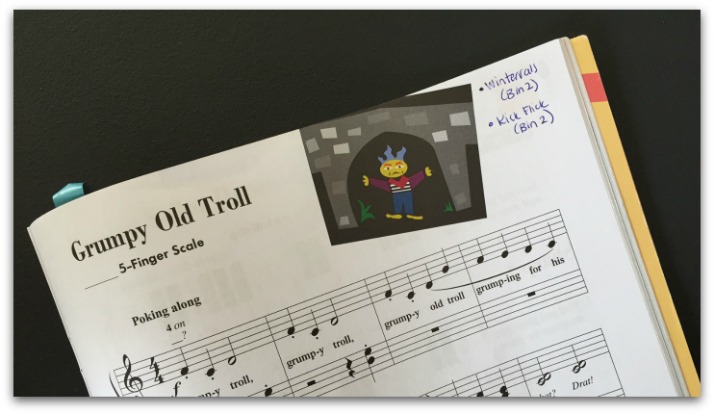
By doing this in advance, I eliminate any time spent deciding which is the correct game to use and then searching through my storage bins to find it. And because the information is directly written on the piano piece that is already open on the piano, it also eliminates the time I might spend opening my teaching binder and referencing a spreadsheet… every second counts!
This strategy requires a bit of prep work, but if you only use two or three method books, you quickly remember which piano games go with which pieces and making the notes before sending the method book home is easy-peasy.
2. Piano Game Days
The first time you play a piano game, you are bound to spend more than 5 minutes learning how the game is played. But once your kids know the rules, playing that game in future lessons takes a fraction of the time.
Because of this, you might want to consider hosting a Piano Game Day one weekend every month or two. During this day, you can teach your piano students how to play all of the fun new games you have.
Then, when your students come for their regular individual lessons, they are ready to roll and no time is wasted learning the games.
Piano Game Days are also a brilliant way to add to your teaching income and to help your piano students meet other music-minded friends, hereby building a sense of community.
3. Game Storage
You’re probably also wondering how to store your piano games so that you can easily grab exactly what you need… and spare yourself from a chaotic studio where spare dice cause tripping hazards and game boards and cards spill from every shelf.
So, I’m going to let you in on my game-storage secret!

As you see in the photo – each of my games has its own folder. Here’s how I set up all of my game folders:
1) Purchase “2 pocket” folders (at the Dollar Tree – 2 for $1.25)
2) Tape the (included) game cover page to the front of the folder.
3) Place the game board in the right-hand side pocket
4) Place the game play instructions in the left-hand side pocket
5) Contain all playing cards, die and game markers that are needed for that specific game in a ziploc bag that is then tucked into the left-hand side pocket.
Store your games in an open basket or bin so you can see the title labels easily, and separate your bins according to learning outcome. I have bins labelled as “1: Rhythm”, “2: Note Reading”, and “3: Ear Training” to name a few. Larger game items (chalk, balls, percussion instruments etc.) go in a bin with a lid… learned that lesson the hard way 😉
With this system you can find the exact game that works to reinforce your lesson focus, have everything you need to play immediately at your fingertips (including instructions if needed), and know exactly where to find each game folder.
4. Take-Home Piano Games
Reaping the many necessary benefits of game-based learning does not only need to happen during a piano lesson!
Consider creating Take-Home Game Bags that your students can check out and take home every week. This is a great strategy for reinforcing lesson concepts AND, what I consider to be even more important… getting parents involved in home practice!
If you choose to become a PianoGameClub member you’ll have new games every month to make a program like this a smashing success!
My Final (And Most Important) Strategy… errrr Philosophy
Truth be told I believe there is ALWAYS time for piano games.
I came to realize this when I started to think of them not as games, but as teaching tools. Then, suddenly, game-based learning became much more than a brain-break… it became a philosophy.
And this philosophy is guided by one very simple question:
“Can what I am about to explain be better off learned with a piano game?”
By adopting this philosophy, you’ll discover, as I did, that there is no need to “make time” for piano games. Piano games become a necessary component of any lesson, and a necessary tool that results in better understanding and increased motivation.
Get A FREE Piano Game!
Now for the best part… we have a great soccer-themed piano game to send your way that will improve bass clef note reading! All you have to do is share with us in the comments below one little time-saving tip that you use to help make the most of your precious piano lesson minutes.
And remember… everyone who leaves a comment will receive the game (Kick Flick) by email 🙂
My game time is my end of month reviews or during regular lessons, for those who finish early. They so look forward to the games and know that time is in essence and it makes them not waste it. Students know that toward the end of the month we will be doing games and it makes them work extra hard to compete with one another on the material for the month. For my slower ones, I always assign a helper so that even if they start playing the game unsure of themselves they end up with the goal: Learning!
I have a magnetic grand staff. While I’m writing, if it’s going to be a minute, I put up a set of pre-written note names and have the student show where those notes live on the the staff with magnets. They can mark any C, any D, etc. If there is still a smidgen of time, I have them play it, also.
Wonderful idea to add creativity to the lesson and smiles on faces! Thank you! I look forward to every email!
My time saving tip is to have everything I need for my students lined up before they come to lessons. Each student has a folder with their owl progress chart, any handouts or new pieces for them this week, and the game we’re going to play somewhere nearby. That way I’m not floundering during the lesson, wondering what we’ll do next.
My time-saving tip is for after lessons – I immediately record my ideas for the next lesson’s activities so I don’t have to wonder about them when the next lesson comes!
I try to rotate through my games so that all my students are well rounded. I get out a few games that work on the same concept (notes, rhythm, terms etc.) each week, then pick the one most suited to the current student’s level or needs. I change the games on the weekend. If I know a particular student is having difficulty with a certain concept, I just make sure I include a game that covers it.
The folder organization idea is great! Thanks!
games help kids relax. Relaxed kids learn
Great advice! I’m finding students are far more engaged when there’s a game involved.
I’d love to see the new “Kick Flick” game. Thank you for all the help.
I have a young boy student who needs some games!
At the end of every lesson, I take 5 minutes to think about the students next lesson and what materials I will need. (I write it in my lesson notebook). Then one week later I get that material out and we have an efficient lesson.
Looking forward to the soccer game!!
I always asked them to tell me what we worked on today and they need to fix in each piece. While they do this, I write them down. This lets them know what they need to work on, and for me to jot down notes as well!
My biggest time-saver is not giving students repertoire so difficult that they can’t work through (most of it at least) independently at home. I always did this instinctively, as most piano teachers do also I am sure. But I didn’t realise this was such an important strategy until I taught some pupils for a friend while she was away. One student, around 8 years old, had repertoire so difficult (for their level) that they couldn’t do any of it accurately unless I went over every single bar of the music with them step by step! It left no time for theory, musicianship, improvising, piano games etc. Very tiring for both teacher and student. I don’t expect my students to get ‘everything right’ straight away. But I do make sure to give them repertoire that they have an understanding of, so at least they KNOW whether they are practicing it correctly or not… without me having to take them through every note and rhythm! This way they don’t get frustrated and it’s so much better for their sight-reading too! If there is a new challenge in a piece we go over that section together and they work on the rest in their own practice time. Then it’s bring on the piano games!
I found letting the student choose their beginning activity allows them to get it done, and not be “on their minds” while we’re working on other parts of their lessons.
Love all the resources you provide!!!! Thanks a million times!!!!!
I am new at this and just started teaching my 5-year-old grandson. I need all the help I can get and love the idea of games.
I always spend the last five minutes on a game. This also works as a reward for being focused during the lesson.
I keep an assignment book as I’m sure all teachers do. That saves time by knowing all what was assigned right away. I also ask about how the student is, giving them a chance to share anything they want that they would like. Another teacher told me this might be their only chance for one on one attention and I’ve always remembered that.
I try saving piano lesson time by writing down notes (for myself) each week on what we worked on but also ideas for repertoire and games for the next week so when it’s almost time for that lesson I can quickly skim over my notes and grab what I need.
I have the parents that come to the lesson, fill in the notes regarding what was achieved in that lesson and homework practice for the week. Most parents make wonderful secretaries.
I make flashcards for scales with the name of the scale on the front and the #s and bs needed on the back – it stops them needing to read the scale from a scale book. For my more advanced students, I give them the blank template and list of scales, they then have to fill in the flashcards and give it to me for me to laminate.
I’m looking forward to using some more fun ways to learn though with music games!
If I’m worried about running out of time for games at the end of the lesson, I’ll start my lesson with a game! That way, I’ll be sure to get it in! If I feel I don’t have enough game time with a particular student, sometimes I will increase lesson time, in order to be sure I can play games! I think games are so important in learning!
I love sticking post it strip reminders on music instead of writing lesson notes in a notebook. Saves everyone time, and the kids see exactly what needs work that week.
I like to have all equipment needed out at the start of each day, and my printer turned on, so as not to waste time during lessons finding anything or waiting for the printer to turn on!
I love doing games at lessons. It helps break up the lesson and help with their attention
Wow! This discussion is a great resource!
Before my son was born, I taught private lessons. Currently, I teach K-5 General Music. My time saving advice is just common sense, but I needed my principal to point it out before I heeded it: Make it the students’ job to clean up after game time. With a little instruction, kids can do a great job of getting all the game pieces/parts ready for the next group. Save your time and sanity by enlisting the help of students.
Is it too late to comment on this post for the game? I love your post, and also all the comments are priceless. Thank you!
Nope not too late Chris! I’ve just sent you an email 🙂
I like the idea of writing the name of the game in the margin of the piece in the method book.
I need to use more games…sigh! I had old-school training from elementary through college. Piano wasn’t/isn’t fun…are you crazy? It’s work! Sadly, my techie “wired” kids need more than the basics for learning.
Thanks for all the great ideas!!
I would like a copy of your soccer game. I would also like a list of all the piano games you have in your folders and how I can purchase them!
Thanks
In addition to my earlier post, how can I buy Rabbit Ribit, Queen Bee, Moose on the Loose, etc…? I just joined the piano game club, but is there a way to purchase games from previous months? And, I use Faber. Can you publish the games you write on all the pages in the books and tell me how I can buy all those games?
Hi Sandy – I’ve just sent you the links to KickFlick and Ribbit Rhythms. The Rhythm Bee is free on our site. Previous games aren’t yet available but as a current member of PianoGmaeClub you’ll be the first to know when they are! If you notice the top of the game cover page once you download your new set that would have been delivered at sign up we put the learning goal above the title – this way you can match it to your method books (ie. Splash is reinforcing note values… so you could match that with all of the pages in the Faber books that talk about quarter, half and whole notes). Hope that helps!
My time saving idea is watching a clock to space out my time for each song. We try and learn 3 new songs each week, I can’t spend more than 7-8 min on each, or I won’t get through everything.
(hoping for a copy of the game!!)
PS. I love your site! Thanks!!
I teach students in an after school care program at a local elementary school. Since the kids have to come upstairs from the gym (or wherever they may be at the time) to the music room for their lessons, I call the childcare director 5 min. before each lesson so each child will arrive on time, therefore getting their full 30 min. Looking forward to getting the soccer game! Also, can you fill me in about the game club? I somehow missed that post. Thanks!
Finding time to do piano games is something I have struggled with and want to do better. For now, I try to always play a game first thing in the lesson if I didn’t find time for one the week before. Thank you for all your help and resources!
One of the many ways I save time is by saving most of our non-piano chit-chat for when I’m writing assignments down in the notebook, or when they’re unpacking/packing. It’s amazing what they can cover about their day, or week, or vacation while I’m writing down a task!! I don’t ask them to save the chit-chat, I just set the example and they get it. I love to hear their stories, just not in lieu of learning time! 🙂
I keep a folder on my computer with music websites and interactive games. When students arrive early for lessons or parents are a few minutes late picking them up, students log into the games. I like your comment to not think of these as “games” but as teaching tools. Students are also instructed on how to log into the games from their home computer or ipad.
I Love all of these tips and comments, I’m also just starting out as a teacher and all of these tips have giving me a few ideas of my own. I am currently working on creating blank worksheets and filling them in with the notes of the pieces we’re working on so as to reinforce what we’re playing. I’m excited to keep reading all the comments and ideas for improving productivity and I would love to find out about the games! Thank you all so much for sharing this site is a gold mine! Thanx again!
I stumbled upon your website last month and can’t stop reading your blog posts. I am getting ready to begin teaching piano again after a 15 year break and I am so excited to use your ideas. I am planning to be more organized and break up time spent on the bench Thank you! Thank you!
I use a an online classroom timer during the lesson that the students so that the students can see themselves how much activity time is left. They enjoy hearing the “bang” when time is up.
I’ve just started teaching again after 30 years and love getting to work with kids again. I try to visit with them as they come in to the music room and unpack their bags. I let them pick out what song to begin with (it’s usually their best, easiest, or favorite) while I check my notes from the previous week and look over their theory books or worksheets. That gets us off to a good start and the remaining time seems to be better utilized.
My comment is about saving money right now, not time (although it could do that too). I got myself a laminator and the envelope sheets to make my own games at home! LOVE it!
I have a prize box and award points at every lesson. If a student opens up all music and assignment book, and is totally ready to start after I say goodbye to student ahead of him, he/she gets 10 points for just setting up really fast. easy peasy
Thanks for all of your amazing, fun ideas!
I assign 3 “sight-reading” pieces each week and save time by listening to only one of them. Sometimes I choose; sometimes they choose; sometimes we
draw straws (cards numbered 1, 2 or 3).
I recently found you guys. I love all the info you h a ‘ve to share.
To save time and be more efficient I make a checklist for each student at the beginning of the year with their individual goals. Topics include: Repertoire, Scales, Rhythm, Sight Reading, Theory, Technique, Duet, Composer Presentation, One Minute Club, Consecutive Club, etc. That way I can quickly glance over the chart as I prepare for the next days’ lessons to see how we are doing and what the next focus should be.
My most time saving idea of late was to make up individualized Lesson Record Pages that I print out ahead of time and put in each student’s file. That way I do not need to do so much writing to give them understandable and clear instructions to take home. (They go in their binder at the front so they see them as soon as they open it up to start practicing.)
This sounds like a great idea! To save time I use the metranome!
To save time, my piano area is ready to go when the student arrives; Lights, piano …….action. Even my timer is preset. Also, I have practice logs preprinted in 4 sections: Finger Warm ups, Scales (major and minor); Repetoire; practice goal per day at the bottom. Then during the lesson, I just complete and send home with the student in a 3 ring binder so students AND parents will know what should be happening during practice time at home.
I just discovered an awesome little time-saving tool / toy yesterday.
It’s called a “dice trampoline” or “(dancing) dice tumbler”.
Now students can stay / sit in one place and use the cup at the piano (without having to run around across the room if a die rolls too far and then returning to the piano (repeat x times) – although I like using the whole room! 😉 )
It looks cool too. And the dice really bounce as if they were on a trampoline. It sped up my intro game, leaving more time for pieces (and of course one more game at the end of the lesson).
Great stuff!
I got mine in a local toy store, but found the same one online: http://www.bol.com/nl/p/dansende-dobbelbeker-dobbelstenen/9200000027680117/?country=BE
It’s a Dutch website similar to Amazon. I’m sure you can find similar concepts elsewhere on the planet.
To save time I have a file cabinet where I keep all of my games and worksheets filed by category: Rhythm, Note Naming, Intervals, Keyboard, Holiday. I use file folders for my games with the instructions taped to the inside, the game boards in the folder, and a Ziplock bag taped to the side opposite the instructions to keep cards or game pieces.
I teach group piano lessons of 2-6 children at a time. I ALWAYS have a binder for each level with a written lesson plan, which is tabbed and ready to go before each class begins. I get out my materials needed for the whole week in a basket ready to grab in each class so I’m not running to the storage cupboard and looking through storage boxes for that game I need. I have a general routine that the children follow each class but is sometimes altered for our special theme days or performance days. As I am preparing for the next activity during class I have the class work on something independently like making notes on their practice page, highlighting specific symbols or parts in the music. This keeps things flowing and keeps them busy while I can take a quick moment to get out the next activity.