
A 30-minute piano lesson can feel as though someone pressed fast-foward on your clock. Exam prep, recital prep, method book work, technical work, composing, piano games…
… and often it’s piano games that get left behind.
But wait! What if we told you that using piano games in your lessons will actually *save* you time?! How?
When children learn new concepts or review past concepts within the context of a game, they are fully engaged in the process. No time is spent re-directing, re-motivating or re-focusing… you have an eager learner beside you ready to soak it all in! Plus… your piano student will retain information more easily when it is presented in a game-based context because he is completely engaged in the process: he wants to win the game!
Keep reading to find out how you can easily incorporate piano games into your lessons… even when time is tight.

Make Time For Games With These 5 Strategies
So… there it is… the one hurdle to including game-based learning regularly is TIME. Fortunately, you can use a couple of simple strategies to crush that hurdle, and pave the way to studio success…
1. Easy Peasy Method Book Notes
I believe so strongly in using game-based learning, that before I send a student home with a new method book, I first add some of my own notes to the header of each piano piece in the book.
In the header (in a discrete area and in a tidy way) I write down the names of one or two piano games that reinforce the concepts being learned in the piano piece. Along with the title of the game, I also note the bin number where it is stored for quick reference (more on that later).
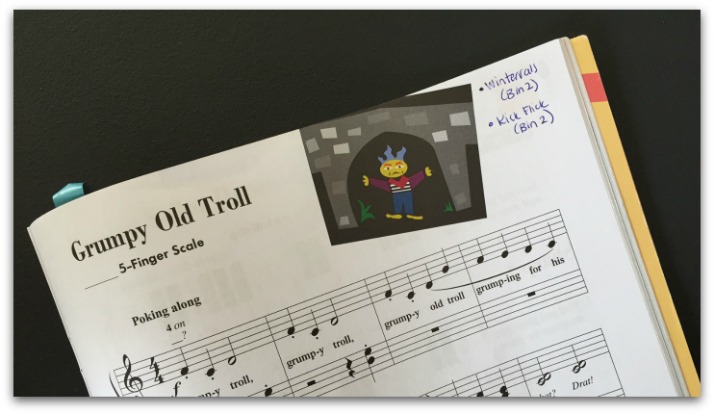
By doing this in advance, I eliminate any time spent deciding which is the correct game to use and then searching through my storage bins to find it. And because the information is directly written on the piano piece that is already open on the piano, it also eliminates the time I might spend opening my teaching binder and referencing a spreadsheet… every second counts!
This strategy requires a bit of prep work, but if you only use two or three method books, you quickly remember which piano games go with which pieces and making the notes before sending the method book home is easy-peasy.
2. Piano Game Days
The first time you play a piano game, you are bound to spend more than 5 minutes learning how the game is played. But once your kids know the rules, playing that game in future lessons takes a fraction of the time.
Because of this, you might want to consider hosting a Piano Game Day one weekend every month or two. During this day, you can teach your piano students how to play all of the fun new games you have.
Then, when your students come for their regular individual lessons, they are ready to roll and no time is wasted learning the games.
Piano Game Days are also a brilliant way to add to your teaching income and to help your piano students meet other music-minded friends, hereby building a sense of community.
3. Game Storage
You’re probably also wondering how to store your piano games so that you can easily grab exactly what you need… and spare yourself from a chaotic studio where spare dice cause tripping hazards and game boards and cards spill from every shelf.
So, I’m going to let you in on my game-storage secret!

As you see in the photo – each of my games has its own folder. Here’s how I set up all of my game folders:
1) Purchase “2 pocket” folders (at the Dollar Tree – 2 for $1.25)
2) Tape the (included) game cover page to the front of the folder.
3) Place the game board in the right-hand side pocket
4) Place the game play instructions in the left-hand side pocket
5) Contain all playing cards, die and game markers that are needed for that specific game in a ziploc bag that is then tucked into the left-hand side pocket.
Store your games in an open basket or bin so you can see the title labels easily, and separate your bins according to learning outcome. I have bins labelled as “1: Rhythm”, “2: Note Reading”, and “3: Ear Training” to name a few. Larger game items (chalk, balls, percussion instruments etc.) go in a bin with a lid… learned that lesson the hard way 😉
With this system you can find the exact game that works to reinforce your lesson focus, have everything you need to play immediately at your fingertips (including instructions if needed), and know exactly where to find each game folder.
4. Take-Home Piano Games
Reaping the many necessary benefits of game-based learning does not only need to happen during a piano lesson!
Consider creating Take-Home Game Bags that your students can check out and take home every week. This is a great strategy for reinforcing lesson concepts AND, what I consider to be even more important… getting parents involved in home practice!
If you choose to become a PianoGameClub member you’ll have new games every month to make a program like this a smashing success!
My Final (And Most Important) Strategy… errrr Philosophy
Truth be told I believe there is ALWAYS time for piano games.
I came to realize this when I started to think of them not as games, but as teaching tools. Then, suddenly, game-based learning became much more than a brain-break… it became a philosophy.
And this philosophy is guided by one very simple question:
“Can what I am about to explain be better off learned with a piano game?”
By adopting this philosophy, you’ll discover, as I did, that there is no need to “make time” for piano games. Piano games become a necessary component of any lesson, and a necessary tool that results in better understanding and increased motivation.
Get A FREE Piano Game!
Now for the best part… we have a great soccer-themed piano game to send your way that will improve bass clef note reading! All you have to do is share with us in the comments below one little time-saving tip that you use to help make the most of your precious piano lesson minutes.
And remember… everyone who leaves a comment will receive the game (Kick Flick) by email 🙂
Sometimes I get stressed and worry if I have prepared enough and get stuck in my head instead of just “flowing” in my lesson. My kids sense it and start getting loud and distracted. So to make my lessons more productive, I just relax and tell myself that I have what it takes and I will do fine.
You’ve changed the way I teach! Thank you for all of the free advice and resources, it makes me even happier to purchase your other materials! Looking forward to this game!
I have things organized by topic so I can quickly pull out an activity for each student .
I recently found you and love all your ideas. I really liked your idea to list games, etc. on pages in the lesson books before giving out lesson books. I find I forget those details in the middle of a lesson. Thanks for sharing all your ideas.
I try to have all new music pulled before students arrive so that I don’t have to spend lesson time digging through my materials if I can help it. Also, I have theory workbooks premarked before students arrive so they can pick up their workbook and get busy while waiting for their turn!
My time saving tip is I have a pocket folder for each student where I keep all my lesson plans, parent information form, and my notes from their progress as well as their points chart for my incentives. Keeps me from hunting for their info each week.
My very best time saving ideas is this: My students understand that if they come well-prepared to the lesson, then we won’t need to spend so much time fixing things during the lesson. That means that we’ll have plenty of times for the piano games. It works like magic!
At the beginning of their lesson, I ask the students which pieces they feel they have nailed. That way I can be sure to listen to those first and spend more time assisting them on pieces they are struggling with if needed. I have REALLY enjoyed the games, and so have my students. I hope I’m not too late in getting this one. Thanks so much for all your ideas and insights. Greatly appreciate it!
Whenever I notice student losing attention, I immediatlt bring out a short game to “bring them back”. Also use many games in music classes.
LIke to use games when I see there is an attention lapse. Also, use them in my studio classes.
I have a notebook for each days students where I keep track of which song they are on in their lesson book and any other important information. That helps me to be able to have the game ready that I would like to use for their lesson.
I make sure the parents make my students warm-up for at least five minutes before I arrive..
To save time in lessons I encourage students to arrive 10-15 minutes ahead of time. I encourage them to make use of my iPad lab with fun games, apps and learning tools.
I also have a printed “order” or “recipe” for how we will start each lesson. I include:
1) take books out of your bag and hand me your binder
2) tell me how your day was
3) stretch
4) play a warm-up piece or scale
etc…. We can’t micromanage or plan every single detail; but we can get things off on the right foot.
When I worked in health care, I had to do charting using a consistent format. Similarly, I chart “next task to work on” every week for each student using the SAME headings in my notes eg. rep, theory, ear, tech. etc.
I then use a highlighter to highlight the most pressing tasks to address that week.
Thank you for these terrific ideas! My studio is still new and already my students are making game requests. I’m new to teaching piano and love feeling inspired by your posts.
I have the students pick out stickers they have earned while I write their assignments in their notebooks.
Super simple and something that everyone does I’m sure, but I try to think of my upcoming lessons the day before and have so I’m mentally prepared instead of winging it in the lesson.
My Tim saving tip is making sure I’m prepared and know what I am going to do in each lesson
I overlap game time and directions for new contests with a departing student and an arriving student. That way I only have to say it half as many times as I have students.
This game sounds great! I teach group piano lessons for our After School program, so I don’t have any earth-shattering time saving tips, but something we do with our time is to have about 3 stations where the students rotate every 10 minutes or so. One is a game station; one is a music keyboard station, etc. It works great and keeps the kids moving.
New to all of these great time saving ideas. Nothing to share at this point but I will be working on being a (time saving) teacher like the rest of you. Thank you!
I have my games organized in plastic baggies.
I print out Lesson Record Pages that are personalized for each student – 2 weeks on each side. This way I just have to fill i nthe details at the student’s lesson. When I have siblings we share game time and do Music Mind Games (or other rhythm, etc material) together.
Love your website. I keep coming back and always get at least a couple of ideas / strategies. The games are such a great idea – I am a new teacher and try to incorporate a game into every lesson. Your idea of writing the games into the student’s method books will save me a TON of time. Thank you!
Fabulous ideas and helps. Everyone is so different! I usually only do games at our Master Classes, but perhaps I could incorporate a few into a monthly schedule. We just seem to have so much already to do! My tip is a binder for each student. A lesson sheet for each lesson. Paper -heavy, but oh my it helps to know exactly what is talked about and what the assignments the student is working on. I also have five or six flash cards taped up and students do the challenge of getting them all right, they get to change out the cards for the next group.
Thank you Andrea, Trevor and everyone here for being so generous with your ideas!
I’m always trying to cut down on the time I need to spend writing in the kids’ practice books – my latest idea is to print out thumbnail stickers of the front covers of frequently used music books to stick in the practice books so I can just write a page numbers and quick reminders (if nec) next to the sticker.
I’m hoping this (along with post-it tabs on pages) will also help early-readers take a bit of control over their assignments.
When it comes time for picking out recital/performance pieces, I let the student sit in my chair and I play through some pieces I’ve selected ahead of time. I have them rate them and write comments about each piece in their notebooks as they listen. Some use color codes, stars, rating numbers, etc. whatever way they want. When we are done they have pretty much decided on one or two pieces they really liked. If they didn’t really care for any of the pieces, I do it again the next week, but not longer. Most of the kids get pretty excited about the piece(s) they chose and I’m always thrilled to see how they’ve really listened to the music and what they wrote about WHY they liked it or what technical part might be difficult for them, etc. AND they’ve heard alot of repertoire!
I teach most of my students in their homes so I utilize my iPad to allow me to have several games at my disposal when I have back to back lessons of students at different levels rather than trying to carry multiple games in my bag. I would love to have some of these games available in an App form!
I am a very recent sign up to your fantastic website – downloaded ‘piano hands shouldn’t flip burgers’ and was totally inspired once I’d finished reading it. I’ve been checking in every morning for new ideas, so looking forward to the piano games.
My biggest timesaver is to write suggestions right on the piece…like do these two measures five times first. I write while they play from another book. Then at the end of the lesson i need to write only the page number and title of the piece in the assignment binder
Love all the ideas. I have some chatterboxes for students, so getting them to focus on what we are learning is a challenge. Doesn’t help when I’m a chatterbox too! I use my computer for lesson notes, then print them for my student at the end of the lesson. I can always email them to the parent if they lose the paper too. I also give my students a folder so they can keep all of their sheet music and lesson notes in it.
my time saving comes with always preparing ahead of time. I have my lesson plans for the week typed up by Sunday.
At the end of each lesson day, I copy supplemental material each student may need for the next week’s lesson while their lesson is fresh in my mind. Then the student doesn’t have to wait for me to copy the assigned song or exercise during the lesson.
Great ideas here! Tips to become better organized & save time during lessons while getting more done is a win-win. A few months ago, I took your game storage advice, but I put *two* games in each folder – I’m trying to take up less space & be frugal. Also, & I know someone here came up with this idea – I’m not this smart!!, I have an 8 x 11 picture frame in which I took out the glass & glued a piece of dark scrapbook paper to a slim piece of metal (purchased from craft or hardware store for cheap!) On the computer, I typed out a bunch of words in a large font to cover every scenario – warm-up, game, technique, repertoire, scales, app, computer lab, recital, etc – cut out the words & glued a small round magnet to each word. For students who need a set order during every lesson, I arrange the magnets on the frame. I can easily swap it out from student to student and it looks good.
Just saw this post.
My tip to save time – I have a folder for each student. The folders belonged to my daughters years ago and so I have one with pictures and I try to pick one that reminds me of the students – I have cats, dogs, horses, bunnies. The pictures makes it easy for me to find the folder. The folders contains their contact information sheet, their stickers, on payment day I put the check or money in the pocket. I also have a sheet with their lesson plans and put games or worksheets or composer history sheets I want to use for the lesson in the folder. If I have new music or books – those also are in the folder. This really helps me to have everything for a lesson in one place and saves time during the precious lesson time in finding what I needs for the student.
Thanks for the great ideas. I have several kids who like to waste time by fidgeting and talking. I remind them early in the lesson that we won’t have time for a game unless they settle down. I usually does the trick.
My kids love to play “the Zap Game” I actually got this idea from John Schmidt. Pretend the piano has an electrical current that runs through the piano into their fingers and up their arm and to their sides…if they play a wrong note and gently “zap” them on their side. It’s an immediate reaction and they really concentrate NOT to get zapped! 🙂
My time-saving tip is that I often write notes to myself on my students’ assignment pages about what I want to work on the following week. I take a scan of the assignment pages with my iPhone and keep it in Evernote, and during the week I will look at that page and be reminded of how to plan for the next lesson.
I’ve been teaching for a long time. Just found you guys this summer (via Wendy Stevens) and my lessons have gotten more fun! Time-wise, I enjoy doing similar exercises, worksheets, activities, games with my students during the same lesson week…having all planned materials at the ready! Looking forward to this month’s new games as well as this soccer game!
I put post-it tabs on the pages I want my students to practice each week and write notes directly on their music. This saves me a lot of time from having to write everything in a notebook and they actually read the notes!
I wish I had a time saving tip to share. This is something I’m still working on and based on all of the previous posts, I now have more ideas to try! One thing helping me for sure is the honor roll system I’m trying out requires students be in time to earn points. It always helps when students have their full allotted time as opposed to it being 5-10 minutes shorter!
Thank you for sharing how you store the games! I’ve been fighting a huge pile for a bit now.
There are so many special projects that I incorporate into lessons, including games, improv, and composition. Because there is limited time during lessons to devote to all of these, I rotate them each month, one week games, another to work on improv. I also send out monthly newsletters to parents with educational info, practice aids, fun music videos, and my composer of the month with listening suggestions.
My time saver is that I made up a generic assignment sheet that covers all the books I use. I make a carbon copy of the sheet and put that copy in my student files.
For some reason I don’t have a rabbit ribit and Ribbit Rhythms. Was that last month’s?
Hi Trish – Ribbit Rhythms was a previously-offered free game. If you search the name of that game on our site you’ll find it:)
I try to include a little game each week or make a game that includes ear training and clap backs. Love your blog.
Thank you for all of your wonderful ideas. Yes, time is a problem for me as I work full time. But, I know your ideas will really add and I’ve barely just begun. Thank you SOOOOO much!!!!
I speed things up I have a 3-ring binder, with a sheet for quick notes, reminders, etc. It also contains attendance, recital infor from last year to plan this year, contact info, and I make a symbol for attitude and preparedness!!
To save a bit of time, I write their assignments on their assignment sheet as they are beginning their lab time. I just can’t tell you how much I am learning from you and all the others who post. I’m becoming a better teacher because of it! Thank you!
Love your ideas on incorporating the games! I now organise them better and this works!
Ideas are great-I’ve used so many already! These games sound like a fun way to use 5 minutes!
1small time-saving thing I do is to use Post-It flags to mark pages. That way I’m not spending time thumbing through the book looking for the page we are on. Love your ideas and look forward to using more games in my studio.
My time saving tip….my 3 ring binder! It contains an attendance register, recital information, music requests from students, contact info for each of them, theory work sheets and new music. I update it weekly with whatever I want to focus on with each student that week. We also play music games on a tablet to reinforce note recognition skills and rhythm.