
A 30-minute piano lesson can feel as though someone pressed fast-foward on your clock. Exam prep, recital prep, method book work, technical work, composing, piano games…
… and often it’s piano games that get left behind.
But wait! What if we told you that using piano games in your lessons will actually *save* you time?! How?
When children learn new concepts or review past concepts within the context of a game, they are fully engaged in the process. No time is spent re-directing, re-motivating or re-focusing… you have an eager learner beside you ready to soak it all in! Plus… your piano student will retain information more easily when it is presented in a game-based context because he is completely engaged in the process: he wants to win the game!
Keep reading to find out how you can easily incorporate piano games into your lessons… even when time is tight.

Make Time For Games With These 5 Strategies
So… there it is… the one hurdle to including game-based learning regularly is TIME. Fortunately, you can use a couple of simple strategies to crush that hurdle, and pave the way to studio success…
1. Easy Peasy Method Book Notes
I believe so strongly in using game-based learning, that before I send a student home with a new method book, I first add some of my own notes to the header of each piano piece in the book.
In the header (in a discrete area and in a tidy way) I write down the names of one or two piano games that reinforce the concepts being learned in the piano piece. Along with the title of the game, I also note the bin number where it is stored for quick reference (more on that later).
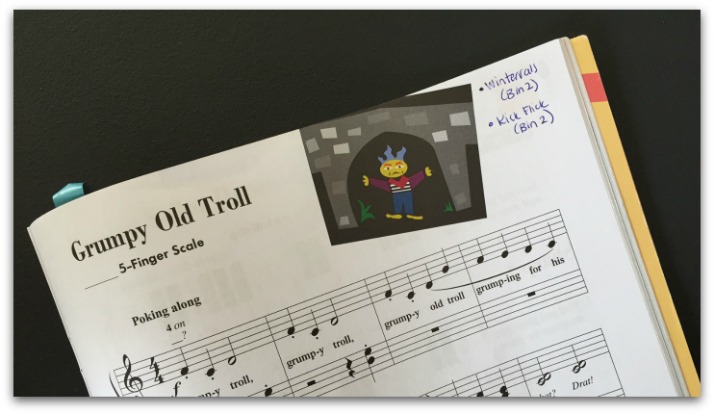
By doing this in advance, I eliminate any time spent deciding which is the correct game to use and then searching through my storage bins to find it. And because the information is directly written on the piano piece that is already open on the piano, it also eliminates the time I might spend opening my teaching binder and referencing a spreadsheet… every second counts!
This strategy requires a bit of prep work, but if you only use two or three method books, you quickly remember which piano games go with which pieces and making the notes before sending the method book home is easy-peasy.
2. Piano Game Days
The first time you play a piano game, you are bound to spend more than 5 minutes learning how the game is played. But once your kids know the rules, playing that game in future lessons takes a fraction of the time.
Because of this, you might want to consider hosting a Piano Game Day one weekend every month or two. During this day, you can teach your piano students how to play all of the fun new games you have.
Then, when your students come for their regular individual lessons, they are ready to roll and no time is wasted learning the games.
Piano Game Days are also a brilliant way to add to your teaching income and to help your piano students meet other music-minded friends, hereby building a sense of community.
3. Game Storage
You’re probably also wondering how to store your piano games so that you can easily grab exactly what you need… and spare yourself from a chaotic studio where spare dice cause tripping hazards and game boards and cards spill from every shelf.
So, I’m going to let you in on my game-storage secret!

As you see in the photo – each of my games has its own folder. Here’s how I set up all of my game folders:
1) Purchase “2 pocket” folders (at the Dollar Tree – 2 for $1.25)
2) Tape the (included) game cover page to the front of the folder.
3) Place the game board in the right-hand side pocket
4) Place the game play instructions in the left-hand side pocket
5) Contain all playing cards, die and game markers that are needed for that specific game in a ziploc bag that is then tucked into the left-hand side pocket.
Store your games in an open basket or bin so you can see the title labels easily, and separate your bins according to learning outcome. I have bins labelled as “1: Rhythm”, “2: Note Reading”, and “3: Ear Training” to name a few. Larger game items (chalk, balls, percussion instruments etc.) go in a bin with a lid… learned that lesson the hard way 😉
With this system you can find the exact game that works to reinforce your lesson focus, have everything you need to play immediately at your fingertips (including instructions if needed), and know exactly where to find each game folder.
4. Take-Home Piano Games
Reaping the many necessary benefits of game-based learning does not only need to happen during a piano lesson!
Consider creating Take-Home Game Bags that your students can check out and take home every week. This is a great strategy for reinforcing lesson concepts AND, what I consider to be even more important… getting parents involved in home practice!
If you choose to become a PianoGameClub member you’ll have new games every month to make a program like this a smashing success!
My Final (And Most Important) Strategy… errrr Philosophy
Truth be told I believe there is ALWAYS time for piano games.
I came to realize this when I started to think of them not as games, but as teaching tools. Then, suddenly, game-based learning became much more than a brain-break… it became a philosophy.
And this philosophy is guided by one very simple question:
“Can what I am about to explain be better off learned with a piano game?”
By adopting this philosophy, you’ll discover, as I did, that there is no need to “make time” for piano games. Piano games become a necessary component of any lesson, and a necessary tool that results in better understanding and increased motivation.
Get A FREE Piano Game!
Now for the best part… we have a great soccer-themed piano game to send your way that will improve bass clef note reading! All you have to do is share with us in the comments below one little time-saving tip that you use to help make the most of your precious piano lesson minutes.
And remember… everyone who leaves a comment will receive the game (Kick Flick) by email 🙂
I try to always start with the piece/assignment that will need the most work, then end with songs that we are reviewing, which makes it easier to cut off the lesson time and play a game before lesson time is over.
Organizational Tip … punch a hole in the zip bag so the air always escapes. I use to use the folder method but now use clear envelopes so that it is easy to see what is there. I can also more easily group activities in one envelope such as keyboard games, a specific season activities, etc.
Lesson Plans … I have a file folder for each student with a “notebook” I make very inexpensively. In this I make weekly lesson notes so I know what I’m going to teach and what I need to collect or do for that student. Also, during the lesson I can make a note of anything I need to be sure to remember for the next lesson. This way I can have everything ready at hand before lesson. Listing an activity in the lesson plans helps to not run out of time or to not forget to do it.
I start every lesson with a quickie game that students can do while I am finishing up a lesson. So as soon as my students step to my door they jump into music.
I have my students play an improvised melody, as I make notes on their assignment sheet. This allows me to evaluate progress ( without my coaching ) while giving them the freedom to explore their own creativity.
I save time by weekly printing out a lesson plan for each child. Before my teaching day starts I put out games and books needed to free my hands and mind. Thanks for all your support to become a more creative teacher.
I’m a bit old school, but I keep a folder for each student and as I find music, worksheets, and activities,or notes for the next lesson, I put it in the folder so I have it ready. Looking forward to changing “theory page” to “game time”
I use sticky note flags as bookmarks for assigned pieces – easier than looking up a page number.
lesson plans with teaching goals/notes, books and page numbers, all written out in advance.
My students come in the door, set their books up open to the correct pages (I use the sticky flags for them so this is easy), while we chat about their day. As we chat I pull their file folder that has everything we need for their lesson. They know we will have a game, so they are usually ready to go at that point!
My time-saving tips are:
1. Students place their books in lesson order before their lesson (as waiting). Warm ups and technical exercise first, because doing them first wakes up the student’s fingers and cuts down the time spent at the piano.
2. Having their theory assignment ready ahead of time, so I am not scrambling to out it together.
3. Post-it notes and flags! I put flags on assigned pages to save time writing down song or page number on their assignment sheet. Only have to note one of the two now. Arrow flags get put on to quickly point out areas to work on.
I have large pocket charts on a stand (with wheels). Each pocket is labeled with a student’s name. I put all their items for their lesson in the pocket so it is handy when needed (unless, of course, it is too heavy.) I can roll the stand out of the studio when not needed.
Do lesson planning by reading though my previous lesson notes, which I make for each student’s lesson. Each student has a coloured file pocket in one binder.
Laura-Lee
I keep a sticky pad handy to write down notes I’ll need for the student for the following week and I stick it on the piano during the lesson. I’ve found when I used to write notes in their folders, I’d miss seeing the notes sooner and not have time to do what I’d written down. Sticky notes on the piano are staring me in the face so I’m sure to remember.
I love reading the comments for saving time in a short 30 minute lesson. Many have said preparation and I agree. I also like to have a smooth transition between students and as I have all students wash their hands before the lessons, this gives me a few moments to write any final notes on the student’s paper, jot a note to myself about what I want to do in next week’s lesson and say a pleasant good-bye.
I color coordinate my flash cards e.g so when I quickly need to pull out bass clef notes I pick out the pink cards etc.
Every student knows to open her/his books to the pieces they worked on and and set them all up on the music rack as soon as they come in, stacked in order of what they want to play first. While they are doing this, I start notating the lesson assignment.
I try to be prepared with diversions for when my emotional students get discouraged. If I have a quick game handy to reinforce their learning and help get their confidence back quickly, it can save a lot of lesson time waiting for them to get their composure. I do acknowledge their feelings, but don’t let them wallow in it. Do something else without hesitation that helps them feel successful and their discouragement usually disappears quite quickly.
I always try to have an “up” game or activity ready that can be varied according to level. Some kids have a hard time just sitting on the bench and need to use their bodies to create or learn or just have fun!
I take game requests the week before, so I can bring it to their homes. It gives them something to look forward to during the week.
I enjoy reading every one elses time saving tips!! I do a lesson plan after each block of lessons – write down the order of pieces/ technic etc and anything new to introduce I write in read. That way the next week when I quickly review what needs to be taught I glance at the red words and decide whether to use a game or anything to teach that concept. I try to list the things I may have missed the previous lesson so I do NOT miss it again as sometimes time gets away and not everything gets heard or addressed.
Thanks for the storage ideas! That is my biggest challenge, finding what I want. I also like it written in the student method book.
Thanks!
Still figuring out my approach so I’m looking for tips more than giving them.
Thanks for all the great ideas on games, I mainly use games in Group classes, using them in regular lessons sounds great! I am a new teacher and am still learning alot, I like flashcards that are color coded to help keep things straight.
Puzzles of different concepts in a bin so for each concept there are several games to play.
Games are so helpful to learn new concepts and reinforce what has been learned.
Andrea, I so appreciate all you do to encourage those of us in the “trenches”! In my studio waiting room I keep a piano for kids to practice on while waiting for their lesson or for parents to pick them up. It gives them time to focus on what’s coming up or practice what we’ve just covered before it leaves their mind!
We also have a studio Ipad that has lots of music games loaded on it. They always have access to it to “play”. Somehow that never seems like work to them
Loved the Ribbit Rhythm can’t wait to see this one! Thank you so much! Love your ideas
So glad to hear it Lisa!
I spend time to save time. Each week I set aside time to write out lesson plans for each student. That way I can have all the materials prepared for when they come to the studio. I don’t write them out in great detail, just a sketch of what I hope to accomplish. It keeps me on track and serves as a reminder of what they are working on. With so many students it’s easy to forget what each one is practicing week to week.
I like the idea of printing out professional looking games without having to design them myself!
At the beginning of each year, I create a folder for each student that contains all worksheets I want them to accomplish for the year(that correlate to lesson plans). During the lesson I can just grab their folder from my bin, and hand out the next sheet to go over.
I am a traveling teacher, so I keep each level of books (in case they forget to bring them), stickers, and games for the lesson in a separate folder in my backpack.
I use the multiple file plastic envelopes from Target (purchased from the $1 aisle) to store my games. I write the fundamental and level on the outside.
I have tried using 3 ring binders for organizing games by type (note reading in a binder rhythm in a binder etc.) but I think I like your folders better…
If I have music or new songs for my students I try to have them printed out ahead of time, and on the shelf with their name on it. That way I don’t have to search through all of my music to find what I want while they wait.
Hi! Love Beth’s idea of using a spreadsheet to keep track of exam students’ progress! I might add that I bet putting that spreadsheet on google docs and sharing it with the student and parent could be an added incentive….to get all the blocks “green”!
Biggest time saver is planning in advance. I have a time slot in Google calendar for my weekly lesson prep time. As I have lessons, I open that time slot and make notes there if I need to find new material, new activities or buy books for a student. At the end of the week, I already have a list of what I need to do but I don’t have to worry ab
I like your idea about keeping games in folders!
Biggest time saver is planning in advance. I have an outline of the lesson time ie 5 min for activity, 5 min per piece, etc. this helps me gauge my own teaching process and keep the lesson moving forward. Also, I have a time slot in Google calendar for my weekly lesson prep time. As I have lessons, I open that time slot and make notes there if I need to find new material, new activities or buy books for a student. At the end of the week, I already have a list of what I need to do and I don’t have to worry about forgetting anything during my lesson prep time.
I too pre-plan lessons, limiting myself to teaching only three new things each lesson be it song section, technical warm-up or at the piano theory. I also don’t spend time listening to a piece that hasn’t been played at home unless I’m concerned that it’s problematic for the student to try it on their own – this is especially useful with the more advanced students… always with the understanding that it’s the first piece listened to the following week.
I print worksheets and games before students come to their lessons. I also have a filing cabinet next to my piano with copies of fun songs, games, etc so it’s easy to grab when I need it.
All of my games are in bins categorized by topic (intervals, rhythm, note names, etc). Before the week starts, I pull out the games I need for each student and put them in a bag I take with me to the studio where I teach. All the prep is done before I ever get to the lesson. No lesson time wasted!
Thanks for the great ideas! I’m looking forward to playing more games!
I am getting into the games for piano. My students are very young and need this for many reasons. Thank you for your ideas.
I have a notebook that I keep by my piano that I jot quick notes in during a student’s lesson…things we need to reinforce, concepts they are struggling with, materials I need to have ready for the following week. At the beginning of each week, I review my notes so that I have everything organized and ready when students come for lessons.
I noticed in the picture above that you use one of the same series of method books that I do (Faber). Is there any chance you would be willing to share what games you have assigned to each song? I LOVE that idea!
I am excited to use these games with some of my younger students who get very antsy on the bench. I think I will leave an extra 5-10 minutes at the end of the lesson to play these games. Thanks so much for all of your ideas. You make teaching exciting once again!
While I write assignments in a notebook for my students (and their parents) I also use little post-it note arrows to point out their pages and the arrows are good for highlighting an area that is tricky. The kids get to pick their favorite color and it brightens things up.
I have colorful, sturdy post-it tabs ready for students to choose and mark the page in every music book they use so they can find their pieces in a snap. Same for their lesson notebook…
I put each game in a page protector. That way the game board is covered and lasts longer. All of the game pieces are stored in the same page protector. Then I put those pages in binders that are labeled in categories similar to your bins. It helps so much to be able to find everything so quickly.
My time saving tip is probably the easiest…I try not to assign too much for the student to complete in a week’s time. I find that if I assign 2-3 songs, technique, theory, flashcards, and more, we just simply don’t have time to get through it all. So I’ve been experimenting with assigning just one song per week, a technique page, and a theory page. The students are retaining information better, seem happier, and their lesson time is not as rushed as it used to be. I think having things better organized will probably help as well…But that takes time that I don’t have much of. 🙂
I always make time to catch up on their school lives for a minute before diving into piano…it makes them more relaxed and ready to play.