
A 30-minute piano lesson can feel as though someone pressed fast-foward on your clock. Exam prep, recital prep, method book work, technical work, composing, piano games…
… and often it’s piano games that get left behind.
But wait! What if we told you that using piano games in your lessons will actually *save* you time?! How?
When children learn new concepts or review past concepts within the context of a game, they are fully engaged in the process. No time is spent re-directing, re-motivating or re-focusing… you have an eager learner beside you ready to soak it all in! Plus… your piano student will retain information more easily when it is presented in a game-based context because he is completely engaged in the process: he wants to win the game!
Keep reading to find out how you can easily incorporate piano games into your lessons… even when time is tight.

Make Time For Games With These 5 Strategies
So… there it is… the one hurdle to including game-based learning regularly is TIME. Fortunately, you can use a couple of simple strategies to crush that hurdle, and pave the way to studio success…
1. Easy Peasy Method Book Notes
I believe so strongly in using game-based learning, that before I send a student home with a new method book, I first add some of my own notes to the header of each piano piece in the book.
In the header (in a discrete area and in a tidy way) I write down the names of one or two piano games that reinforce the concepts being learned in the piano piece. Along with the title of the game, I also note the bin number where it is stored for quick reference (more on that later).
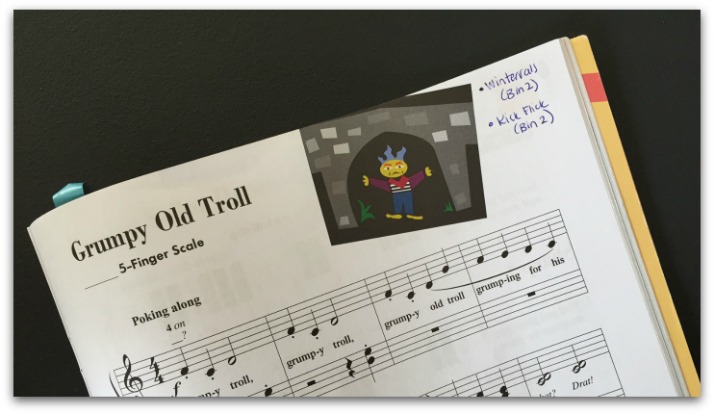
By doing this in advance, I eliminate any time spent deciding which is the correct game to use and then searching through my storage bins to find it. And because the information is directly written on the piano piece that is already open on the piano, it also eliminates the time I might spend opening my teaching binder and referencing a spreadsheet… every second counts!
This strategy requires a bit of prep work, but if you only use two or three method books, you quickly remember which piano games go with which pieces and making the notes before sending the method book home is easy-peasy.
2. Piano Game Days
The first time you play a piano game, you are bound to spend more than 5 minutes learning how the game is played. But once your kids know the rules, playing that game in future lessons takes a fraction of the time.
Because of this, you might want to consider hosting a Piano Game Day one weekend every month or two. During this day, you can teach your piano students how to play all of the fun new games you have.
Then, when your students come for their regular individual lessons, they are ready to roll and no time is wasted learning the games.
Piano Game Days are also a brilliant way to add to your teaching income and to help your piano students meet other music-minded friends, hereby building a sense of community.
3. Game Storage
You’re probably also wondering how to store your piano games so that you can easily grab exactly what you need… and spare yourself from a chaotic studio where spare dice cause tripping hazards and game boards and cards spill from every shelf.
So, I’m going to let you in on my game-storage secret!

As you see in the photo – each of my games has its own folder. Here’s how I set up all of my game folders:
1) Purchase “2 pocket” folders (at the Dollar Tree – 2 for $1.25)
2) Tape the (included) game cover page to the front of the folder.
3) Place the game board in the right-hand side pocket
4) Place the game play instructions in the left-hand side pocket
5) Contain all playing cards, die and game markers that are needed for that specific game in a ziploc bag that is then tucked into the left-hand side pocket.
Store your games in an open basket or bin so you can see the title labels easily, and separate your bins according to learning outcome. I have bins labelled as “1: Rhythm”, “2: Note Reading”, and “3: Ear Training” to name a few. Larger game items (chalk, balls, percussion instruments etc.) go in a bin with a lid… learned that lesson the hard way 😉
With this system you can find the exact game that works to reinforce your lesson focus, have everything you need to play immediately at your fingertips (including instructions if needed), and know exactly where to find each game folder.
4. Take-Home Piano Games
Reaping the many necessary benefits of game-based learning does not only need to happen during a piano lesson!
Consider creating Take-Home Game Bags that your students can check out and take home every week. This is a great strategy for reinforcing lesson concepts AND, what I consider to be even more important… getting parents involved in home practice!
If you choose to become a PianoGameClub member you’ll have new games every month to make a program like this a smashing success!
My Final (And Most Important) Strategy… errrr Philosophy
Truth be told I believe there is ALWAYS time for piano games.
I came to realize this when I started to think of them not as games, but as teaching tools. Then, suddenly, game-based learning became much more than a brain-break… it became a philosophy.
And this philosophy is guided by one very simple question:
“Can what I am about to explain be better off learned with a piano game?”
By adopting this philosophy, you’ll discover, as I did, that there is no need to “make time” for piano games. Piano games become a necessary component of any lesson, and a necessary tool that results in better understanding and increased motivation.
Get A FREE Piano Game!
Now for the best part… we have a great soccer-themed piano game to send your way that will improve bass clef note reading! All you have to do is share with us in the comments below one little time-saving tip that you use to help make the most of your precious piano lesson minutes.
And remember… everyone who leaves a comment will receive the game (Kick Flick) by email 🙂
I keep a folder for each student, in which I paste a chart of what is assigned each week and a chart of goals. I will include games to be played as well!
Thank you again for your generosity. I’ve used your games extensively. 🙂
At the beginning of lessons, I have my kids practice on a piece to warm up while I am writing in their assignment folders for the week. Of course, I am listening as I am writing, and can already comment on the piece after I finish writing.
I love your ideas for storage. I have so many games that I have made/collected over the years, I need to organize them better so I can use them more effectively! I’m excited to see some of your new games too!
I picked-up twelve scrapbook storage boxes of different colors (the ones that are 12″ x 12″ x 3″ and stack easily in a closet). My goal this year is to stay ahead of the holiday/seasonal curve by filling each with games, worksheets, supplementary music, and reward stickers which match the months. I’m currently working on my orange Halloween box of fun. The size of the boxes is perfect for a stack of folders/papers and leaves room for stacks of game cards and seasonal-related extras like erasers which can be used as game pieces. I also found a game of Boogle at a thrift store and have split up the dice so there is a set in every box ready to go. I think what I’m most excited about is that I will never miss “Talk Like a Pirate Day” ever again!
I keep a hanging file folder beside the piano with a file for each student. When I purchase or print sheet music for them, it goes into their file, with the bill attached, so it’s easy to pull out and get started on right away. I also print out a lesson assignment page ahead of time for each student, so that I just have to fill in the blanks with assigned work, rather than write everything from scratch every week.
I give the student the lesson plan at the beginning of the lesson, so they know what to expect, and they love to help keep me on track to get through the list!
Thanks for your great ideas on your website. I organize my games in large numbered plastic storage bags that are hung on a rod. I have a numbered master list with the games listed and that way can quickly find what I’m looking for and in turn quick to put away.
One tip I have started using that saves time for me and for my students is putting a paper clip on top of the pages that we are working on in each book. The lesson book has a clip on the songs we are doing, the theory book, note book etc. Saves me time when finding a song, and the student is not flipping through pages during their practice time.
I like this idea! Thank you.
Someone already shared this, but I let students pick out a sticker for each piece they “pass” as I write down their assignment. It gives them a short mental break and gives me the time I need to write things down!
Same here! Sometimes they peruse those stickers for awhile before deciding which one and where to stick it. LOL!
I love having games available when students forget their materials or have had “one of those weeks”. By using games at these kinds of lessons the students still learn something although it wasn’t exactly what you planned for them.
Storing and locating the games are the hardest part for me. I love your idea about the folders & bins.
When there aren’t many new concepts to learn in a new piece, I help students find the spots that might cause problems and then assign the new piece as sight reading. It gives them the confidence to tackle new pieces on their own and helps me assess their learning style when I hear the piece the next week.
Love your blog and would love to subscribe to the Piano Game – invaluable resource!! Thank you!
I have the students write their own practice time on the chart and immediately sit down and play a warm-up or memorized song. This saves me time and gets them playing right away.
I try to take 15 minutes or so before the start of my teaching day and decide what game(s) the students for that day are going to play. Then I get those games out of the bin and have them ready to go. If all else fails, there’s always Rhythm Cups Explorations (by Wendy Stevens)!
I set a timer for each lesson within view of myself and my students. I’ve found that it really helps us stay on task. And, my students know that when it gets down to the last 5-7 minutes, it’s time to close the books and play a game.
This year I am keeping a binder with notes on each student. Each day I review my notes from the previous lesson so I will be ready for what we need to do at their lesson. I have just started doing games the last couple of years and love it! Thanks for all of your wonderful, inspiring ideas!
I’ve started using a different approach to games and fun activities. Every week, there is a different skill or concept. For instance, this week was “sharp week”. I collected resources such as games, attractive worksheets, and manipulatives to teach something about sharps and half steps. The materials are graded, organized, and stored from primer level through level 4, so “sharp week” is appropriate for everyone.
I have a parent attend the lesson and they are responsible for writing down the assignment as we go through the material. Then I just take a picture with my iPad which I keep in each student’s “folder” in the app, Note Taker HD. That app has really simplified and eliminated a lot of paper in my studio.
Thank you for your great ideas.I am looking forward to new games!
I love playing games! I find our time on the bench is more effective when the concept I’m teaching is first reviewed with a game.
During each lesson I jot down a particular struggle in the lesson, a positive comment the student made, words of wisdom from me, something their parent said about piano practicing – basically just anything I want them to remember. I have a music stand right there where kids come in the door to my house for their lesson. On that stand I put a personal message to the student or maybe a message for all my students. I want them to walk in the door & immediately start thinking about piano – leaving the troubles of the day, what they had for lunch, who they played with at recess, or whatever is on their minds BEHIND them. Actually I have several music stands for this purpose. It puts them in the right frame of mind when it’s time to approach the piano bench for their lesson.
I use your idea of having the lesson components on the wall as a mini schedule. I have them laminated and use a clothes pin to follow along as we go to each area.
I believe in hands on activities especially after being a special ed teacher for years. My problem is organization so I can get to it quickly. I might as well break down and get organized.
I have a “game of the week.” I find that even beginner students can learn rhythms that haven’t been introduced in their songs, intervals that haven’t been introduced in songs, etc. They can go ahead and learn the concepts and be working on them. So everyone plays the same game, no matter what their level.
I often like to start a lesson with a little FUN duet sightreading with my students, and I try to have an appropriate choice all picked out and propped up on the music stand before they come into the studio.
I don’t always use games as such, but fun things are built into my teaching. I usually have times when games will work for lots of folks. Then bring out the boxes/bins.
Thanks for your ideas.
I love the method book game organization!
I’ve just organized my games similarly to yours. It must have been your inspiration. Thank-you
I have an Excel spreadsheet that I use to keep track of my games and what concepts they cover. Love the folder idea, especially for the printable games. Right now, I have mine inside sheet protectors.
My tip: plan ahead! I make sure to choose which game I would like to play and how it fits into the lesson ahead of time so I know it’s gets added.
I use a spreadsheet tool to plan each student’s lesson, which I update with practice notes during the lesson. At the end of the lesson, I print the practice sheet (lesson plan has now been transformed into a practice sheet) for the student, who picks up the printout and puts it into his/her binder. Now my students don’t have to decipher my squiggly writing.
I still struggle getting it all organized to have the right game for the right student. And then if they are tired, coming straight from school, and need to dredge up more brain power for playing their assignments, they are slow in response and the game takes 10 minutes instead of the intended 5. So, I’m not offering a “time-saving” tip but rather feeling frustration in joining this wagon train.
I bought a notebook made for teachers and use it through all my lessons to make notes on what the students are learning or struggling with. Then the next week I can easily look at my notes and know what to prepare for at each lesson.
To save time I have a few notes of my goals for each student and whatever materials I need are paper clipped together and ready to use when the student comes.
The last 5 minutes of each lesson I review with the parent what
activities and songs I introduced so the student can work on them
during the week. Great way to get parents involved.
One day a week i take time to prepare all my students’ lessons. I check and record their theory work, write up a plan of what i hope to accomplish for each one, pull new music and games, make necessary adjustments in Quickbooks, and partially fill out each student’s new practice plan. Most of that goes in each student’s folder. At the beginning of each day i pull the folders for that day and we’re off and running.
Have all materials ready to go. If I run out of a page, it takes too much time from a lesson. I try to print any pages that I need for the whole semester or teaching year.
To those students who appear to be jumpy and mind-wandering at the beginning of lessons, I will tell them that there is a game for them to play if they show me how to stay focused. All of a sudden, their faces will light up, and they are ready for the lessons. They love games.
THANK YOU so much, again for all you do to help us piano teachers (and 21st century piano students) out! I love the game storage idea- brilliant!!
I, too, use a notebook where I jot down what each student is doing. It helps me keep up with extra music sheets I think each student may enjoy, and also what game would be appropriate for the next week’s lesson. Having all the information in one place makes it easy.
Thank you, thank you, for the games and more on your philosophy. I believe that games are of great benefit, but have been concerned that parents might wonder about it. I’m going to find one that I can send home with students, so parents can get more involved in the fun! And your storage ideas are great! Thank you so much for bringing new life into my teaching, and my students thank you!!
You could include a comment about the use of games in your studio policy. I have never had a parent complain about teaching materials.
My time saving tip – I have a folder for each student. In it I have lessons notes on what happened at the lesson and any comments for me for the next lessons – things to prepare or topics to cover or review. Also in the folder is their accounting page (don’t have to search elsewhere to know), notes on lesson scheduling changes, page of reward stickers, any games or worksheets I want to use during their lesson, music that I have for them and any correspondence to send home. This folder keeps me organized and less time is spent looking for things for the student or forgetting things I want to cover or have for them.
I have games picked out before the lesson (I usually have in mind what I plan to do over the course of the month), and I will often use them to indroduce a new concept rather than just explain it (which saves a lot of time, and usually makes the concept stick more quickly), then we usually go back to the piano to learn a piece to put what we learned into context.
I have “Piano Parties” (group lessons) on the 5th weeks of the month, where the group meets for an hour lesson. I have “Tuesday students” come at a designated time on Tuesdays, Wednesday students, on Wed. and so on. We have a “mini-(student only) recital”, and talk about audience and performing protocol, and then we play 4 to 6 games to reinforce and strengthen rhythm, note-reading, theory concepts, etc. These are the most anticipated lessons of the year! I’m able to explain the games to a group, and we play them, and then that saves time when I want to bring them out again for a quick review, or fun addition during individual lessons. Also, (as was mentioned by others) if I have a game I want to introduce during private lessons, I’ll combine a waiting student or sibling with the current student for one explanation, and run through it when they have a buddy to play with besides me 🙂 Thanks for the many, many great ideas and helps with your wonderful website!!!
HI ANDREA: oh you mentioned that you hope we enjoyed the Ribbit Rhythms game but actually I am still waiting to receive my Ribbit Rhythm game!!! It hasn’t come through my email so I just assumed it was taking awhile for you to send out so many! Did I miss something? I left a comment Monday but please let me know what else I need to do.
TIME SAVING TIP: I keep a clipboard on my lap that contains a planned page for each student’s lesson for the week where I have a CHECKLIST with little boxes for each thing. As we go through the lesson, I check off the things we do or put an X in the box if we didn’t have time for that thing or if I changed my mind,etc. Then WHEN THE LAST STUDENT FOR THE DAY LEAVES, I quickly make a new checklist for each student that just left WHILE THEIR LESSON IS FRESH ON MY MIND. Otherwise if I wait too long, I forget what we even did in the lesson, even with the checklist. I have a copy of each method book so I’m able to look ahead and plan next week. So at the end of the day, their lesson for next week IS ALREADY PLANNED! I don’t have to pull the checklist out again until one week later. This works GREAT for me! So I’m able to use more time for other things, such as newsletter, recital planning, online research for piano teaching, making games, etc.
Hi Robyn – just re-sent Ribbit Rhythms to you 🙂
I have started writing a list of what we are going to do at the next lesson, at the bottom of each students assignment page for that week. That way when I open it up the following week, I don’t have to try and remember what I wanted to do- its right there! Also, it lets the students know what we are going to work on ahead of time so they can focus on those things during the week (assuming they actually open their assignment notebook when practicing…)
If I plan ahead for a specific student it always goes better.
I’m a brand new piano teacher, so I don’t know if I have any “tips”. But I have found (like others here) that keeping a record of each student’s lesson and what we covered helps me better prepare to manage time wisely for the next lesson.
I have three small tips:
1. Planning the games in advance. Usually in my yearly calendar, I pick out 3-4 games I want to use each month. Included in those are seasonal games and I try to have one game per concept (i.e. a rhythm game, a note reading game, a theory review game). I plan this out on my yearly calendar and games I find during the year I slot in wherever there’s a gap. Easy planning!
2. Use games at group classes. I have a Halloween piano party, Christmas camp and Summer camp. These would not be complete without games!
3. Watch the clock. I ALWAYS save the last 5 minutes of class for the game. I think of it as their “theory book”… only a lot more fun!